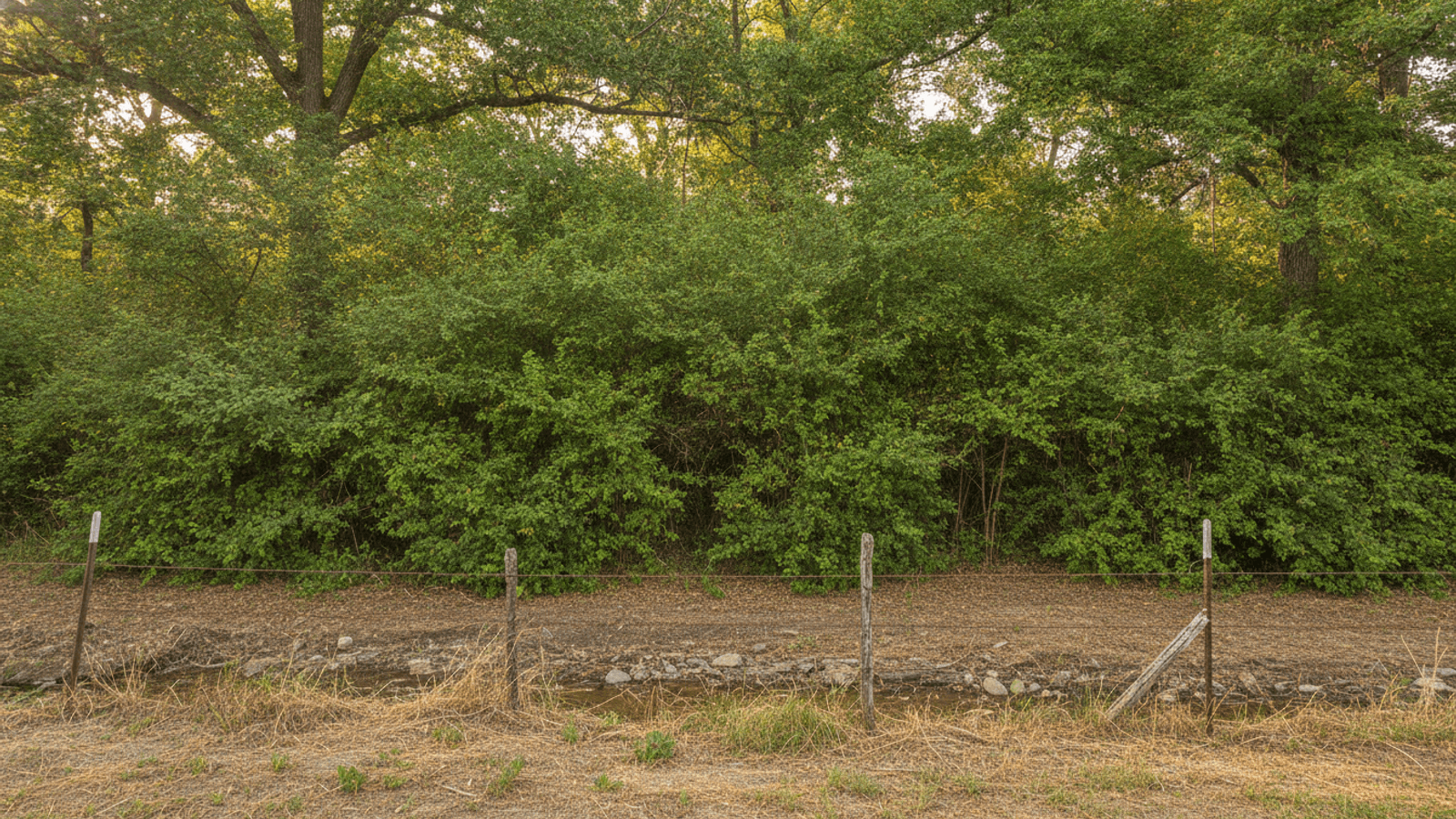
That wall of green brush along your fence line or creek is probably Amur honeysuckle, and as of May 2026 it sits on the Kansas Noxious Weed List. Under Kansas law, controlling a listed noxious weed on land you own or supervise is your responsibility, not an option. The upside is that the same listing opens the county’s cost-share herbicide counter to you.
This guide covers what the listing changed, how Shawnee County enforces it, when the treatment windows fall, and what to verify before you hire anyone. Confirm current requirements for your parcel with the Shawnee County Weed Department before work starts.
What changed in May 2026
The Kansas Department of Agriculture added Amur honeysuckle to the state’s noxious weed list in May 2026, along with spotted knapweed, diffuse knapweed, common teasel, and cutleaf teasel. Pignut came off the list. Jeff Vogel, the department’s plant protection and weed control program manager, told Kansas Reflector it had “been more than 20 years since additions were made to the list.”
Two clarifications matter before you start cutting. First, this is the bush, not the vine. Vogel noted that Amur “is a type of honeysuckle that grows as a bush, and doesn’t include Japanese honeysuckle, which is a vine.” Second, K-State Research and Extension treats several look-alikes as one management group: publication MF3222 describes “Asian bush honeysuckles (Lonicera maackii, L. tatarica, L. morrowii)” as “invasive, woody shrubs that form dense stands in environments ranging from sun to shade and from wet to dry soils.”
Topeka sits in the part of the state where this shrub is thickest. The Kansas Forest Service puts it plainly: “While their presence is most concentrated in the eastern third of Kansas, significant infestations have been documented throughout the state.”
What Category C actually requires of you
Amur honeysuckle went on as a Category C weed. K-State’s summary of the changes defines the three tiers: Category A weeds “are managed for eradication,” Category B weeds “are managed to prevent spreading,” and Category C weeds “are managed to reduce negative effects.” Category C weeds, it adds, “have extensive, well-established populations in Kansas.”
So Category C is the pragmatic tier. Nobody expects Shawnee County to be honeysuckle-free next spring. The duty is still real, though. As K-State states it, “under Kansas law, landowners and managers are required to control noxious weeds using approved methods.”
Vogel described the intent as containment plus access to help. “The idea is to try to prevent the spread and the production of seeds or reproductive parts,” he said. “But I think more importantly here, too, is that this gets our county weed departments involved. Counties offer cost-share herbicides for our noxious weeds.”
Mark Furry, Sedgwick County’s noxious weeds director, read the category the same way: it means “you’re not to allow the honeysuckle to spread to other people’s property and you must try to eradicate it on your land.” He added that officials “understand that it’s probably not going to happen, and especially in the next couple years, it’s not going to happen, so you know, as long as you’re working on it and it’s not spreading to other people’s property, there’s a lot of leniency as far as the law goes.”
Read that as direction, not as a specific ruling on your property. Enforcement is a county call.
How Shawnee County enforces it
The Shawnee County Weed Department “enforces the Kansas Noxious Weed Law, K.S.A. 2-1314 et seq., for Shawnee County” and is “responsible for enforcing noxious weed control on private and public property in all areas of Shawnee County.” It also “acts as a liaison between neighbors with invasive noxious or nuisance weeds,” which is the line worth remembering if your problem started on the other side of a property line.
The county’s own definition of the standard is narrower than “get rid of it.” Control means “preventing the production of viable seed and the vegetative spread of the plant.”
The department’s published notice spells out what happens if that notice is ignored. The county may serve “a legal notice requiring control of the noxious weeds within a minimum of five days.” If the weeds aren’t controlled in the time allowed, that “may result in the county treating the noxious weeds at the landowner’s expense and placing a lien on the property if the bill is not paid within 30 days.” The alternative path is “filing criminal charges for non-compliance,” where “conviction for non-compliance may result in a fine of $100 per day of non-compliance, with a maximum fine of $1500.”
In practice, county directors quoted on the new listings described starting with education rather than penalties. Rich Rodvelt, Brown County’s noxious weed director, said his county sends a letter first and has not, in his memory, taken the step of removing weeds and billing the landowner. That is his county’s practice, not a guarantee about yours. Assume the notice is the beginning of a clock.
Are you sure it’s Amur honeysuckle?
Get the identification settled before anyone sprays anything. MF3222 notes the shrub “is often found on disturbed sites, forest edges and interiors, floodplains, fields, pastures, and roadsides,” which describes most of the wooded edges around Topeka and Shawnee County.
The strongest tell is seasonal, and it’s the same trait that sets up the treatment window. Vogel said Amur honeysuckle leaves stay green longer than most plants. In late fall, when the oaks and hackberries around it are bare, a honeysuckle stand is still holding green leaves. If you’re unsure in September, mark the location and look again in November.
If you want a second opinion on what’s growing there and what it’s doing to the trees above it, confirm identification with a source you trust before anyone sprays, and a tree health assessment can address the condition of the canopy trees the shrub is growing under.
Cutting alone will not work
This is where most homeowners lose a season. MF3222 is direct about it: “Bush honeysuckle has a shallow, fibrous root system that readily resprouts after being cut back. Complete removal may be needed to limit regrowth.”
Mechanical work still has a place. “Hand pulling and removal of seedlings and small plants is effective in light infestations, but larger equipment may be needed for robust, dense stands of bush honeysuckle.” The same publication flags a side effect worth planning around: “Mechanical removal may result in soil disturbance, so care should be taken on steep slopes and sites prone to erosion.” On a creek bank, that matters.
K-State’s guidance on the new listing recommends pairing the two approaches. “Repeated sheep and goat grazing or mechanical removal methods can suppress Amur honeysuckle, but combining mechanical or grazing control with herbicide treatment to address resprouting is recommended (e.g., cut-stump applications).” There is no shortcut waiting to be discovered, either. MF3222: “Treatments fall into one of two categories: mechanical or chemical. No biological controls currently exist.”
Clearing a dense stand is closer to brush work than to trimming. If the thicket runs across a large area, our guide to what land clearing actually costs around Topeka covers how access and disposal drive the price, and lot clearing is the service category that fits. Plan the debris side too, because a cleared stand produces a lot of brush. Tree debris disposal in Topeka covers the wood and brush options.
The treatment windows, and where September sits
Two windows matter, and they’re different jobs.
Cut-stump, late summer through the dormant season. For larger stands, MF3222 says they “can be treated by applying a 25 percent solution of glyphosate to stems that have been cut at ground level,” and that “application from late summer through the dormant season is effective.” Triclopyr is the other cut-stump option: it “is most effective in late winter” and “is more effective at controlling large bush honeysuckles with stems that are larger in diameter.” So if you’re cutting in September, treat the cut stumps as you go rather than coming back later.
Foliar spray, late fall. The reason to wait for November is selectivity. MF3222: “To limit effects on other plants, consider spraying in late fall, when only bush honeysuckle bears green leaves and desirable native plants are dormant.” For spot work, it calls a “1 to 2 percent solution of glyphosate” effective, “especially on regrowth from previously cut stems,” while “carefully avoiding overspray on nontarget species.” Cold is less of a limit than people assume: “temperatures as low as 40 degrees have not reduced honeysuckle mortality after treatment.”
Furry recommends staying in those windows and staying with one product. “I’m personally only going to recommend one type of treatment, and that’s either an early spring or a late fall treatment with glyphosate,” he said, because other products that work on bush honeysuckle “can kill a lot of other trees around it that homeowners don’t want to kill.”
MF3222 backs that caution on one product by name: picloram, sold as Tordon and others, “controls bush honeysuckle infestations, but can result in unintentional tree kill and must be applied with caution in wooded areas.” Near water, the publication points to different chemistry: “for treating riparian woodlands, wetlands, or sensitive areas near water, consider aquatic formulations (such as ‘Rodeo’).” Always follow the product label, which K-State restates as the final word: “always consult the herbicide label for the most current use requirements.”
Set expectations on the calendar, too. Furry expects areas thick with Amur honeysuckle to take several years to clear, and suggested working inward, clearing perhaps ten feet into the woods one year and going farther the next.
What Shawnee County will help you pay for
This is the part of the listing that works in your favor.
The Shawnee County Weed Department “maintains a warehouse and sales counter to provide cost-shared herbicide controls and rental equipment to landowners.” The products “can only be purchased for land in Shawnee County,” and the department is “licensed to sell these products for NOXIOUS WEED CONTROL ONLY.” The counter is at 2044 SW Western Ave in Topeka, and chemical sales and equipment rental run Monday to Friday, 8 am to 4 pm, with the office open until 5. The department’s phone is 785-251-6931 and the director is John Landon.
Sprayer rental is subsidized the same way. The daily rate is $20.00 for a 24-hour period, and the weekend rate is $40.00 if you rent Friday and return it before 9:00 am Monday. Units are first-come, first-served, though the department will hold one if you call and are on the way. Those sprayers are pasture units built for acreage, not for a backyard hedge, and they’re “for noxious weed control only.”
On which products qualify, K-State’s summary of the new listings says herbicides eligible for cost share on Amur honeysuckle “include 2,4-D, glyphosate, imazapyr (Arsenal, others), picloram (Tordon, others), and triclopyr (Remedy, others),” and that “applications can be made in early spring, before desirable species leaf out, or in the fall after desirable species have dropped leaves.” Picloram (Tordon, for example) controls bush honeysuckle infestations, but can result in unintentional tree kill and must be applied with caution in wooded areas. Confirm current stock, pricing, and eligibility with the department rather than assuming a product is on the shelf.
There’s a second program worth a call. The Kansas Forest Service “supports and encourages the removal of Asian bush honeysuckle from both private and public lands” and directs landowners to “contact the KFS State Office at (785) 532-3300 for more information on our backpack mist-blower loan program or other assistance opportunities.” Mist blowers have their own window: MF3222 says the window “is in late fall, when native plants have gone dormant and only bush honeysuckle retains its leaves,” and that at the right time of year “it is common to treat 1 to 2 acres per hour effectively with little impact on nontarget species.” Not every glyphosate product is cleared for that equipment, so check the label: “glyphosate is available in many formulations and brands, but not all are labeled for use in mist blowers.”
What to ask a provider before hiring for honeysuckle
Honeysuckle work sits between brush clearing and chemical control, and not every crew does both halves.
Ask which parts of the job the written scope covers: cutting, cut-stump treatment, hauling, follow-up on resprouts, and how many visits are included. Resprouting is the default, so a one-visit quote with no follow-up is quoting a different job than the one you have. Ask who is applying the herbicide and what Kansas pesticide applicator credentials they hold for that work, and where you can verify it. Confirm insurance and get the scope in writing. If the stand is growing up into your canopy trees or along a shared boundary, say so up front, because access and neighbor coordination change the plan.
For smaller ornamental hedge work that isn’t a noxious weed problem at all, the pricing and timing questions are different. See hedge trimming cost in Topeka and hedge and shrub care.
Frequently asked questions
Do I legally have to remove bush honeysuckle in Kansas?
You are required to control it. Amur honeysuckle was added to the Kansas Noxious Weed List in May 2026, and under Kansas law landowners and managers are required to control noxious weeds using approved methods. Shawnee County defines control as preventing the production of viable seed and the vegetative spread of the plant. Confirm what applies to your parcel with the Shawnee County Weed Department.
What happens if I ignore a noxious weed notice in Shawnee County?
The county’s published notice describes serving a legal notice requiring control within a minimum of five days. Failure to control within the time allowed may result in the county treating the weeds at the landowner’s expense and placing a lien on the property if the bill isn’t paid within 30 days, or in criminal charges, where conviction may bring a fine of $100 per day up to a maximum of $1500.
When is the best time to treat bush honeysuckle in Topeka?
There are two windows. Cut-stump treatment with a 25 percent glyphosate solution is effective from late summer through the dormant season, and triclopyr cut-stump is most effective in late winter. Foliar spraying is best in late fall, when only the honeysuckle still has green leaves and desirable natives are dormant.
Why does my honeysuckle keep coming back after I cut it?
Because cutting alone doesn’t stop it. Bush honeysuckle has a shallow, fibrous root system that readily resprouts after being cut back. K-State recommends pairing mechanical removal with herbicide treatment, such as a cut-stump application, to address the resprouting.
Does Shawnee County help pay for honeysuckle herbicide?
The Shawnee County Weed Department maintains a sales counter providing cost-shared herbicide and rental equipment to landowners, for land in Shawnee County and for noxious weed control only. Sprayer rental is $20.00 per day or $40.00 for a weekend. Call 785-251-6931 to confirm current stock and pricing.
Is Japanese honeysuckle on the Kansas noxious weed list too?
No. The listing covers Amur honeysuckle, which grows as a bush. Jeff Vogel of the Kansas Department of Agriculture noted the addition does not include Japanese honeysuckle, which is a vine.
Getting the honeysuckle off your property
Start with two calls. Ask the Shawnee County Weed Department at 785-251-6931 what applies to your parcel and what’s on the cost-share shelf right now. Then decide whether the stand is small enough to handle with a pair of loppers and a cut-stump application, or dense enough that it needs equipment and a multi-year plan.
Topeka Tree Pro connects homeowners in Topeka, Silver Lake, and across Shawnee County with independent insured tree-service providers. Ask the provider you select to inspect the actual stand, the access, the slope, and the trees growing above it, then put the scope, the follow-up visits, and the applicator credentials in writing. Call (785) 333-4052 to request an estimate.