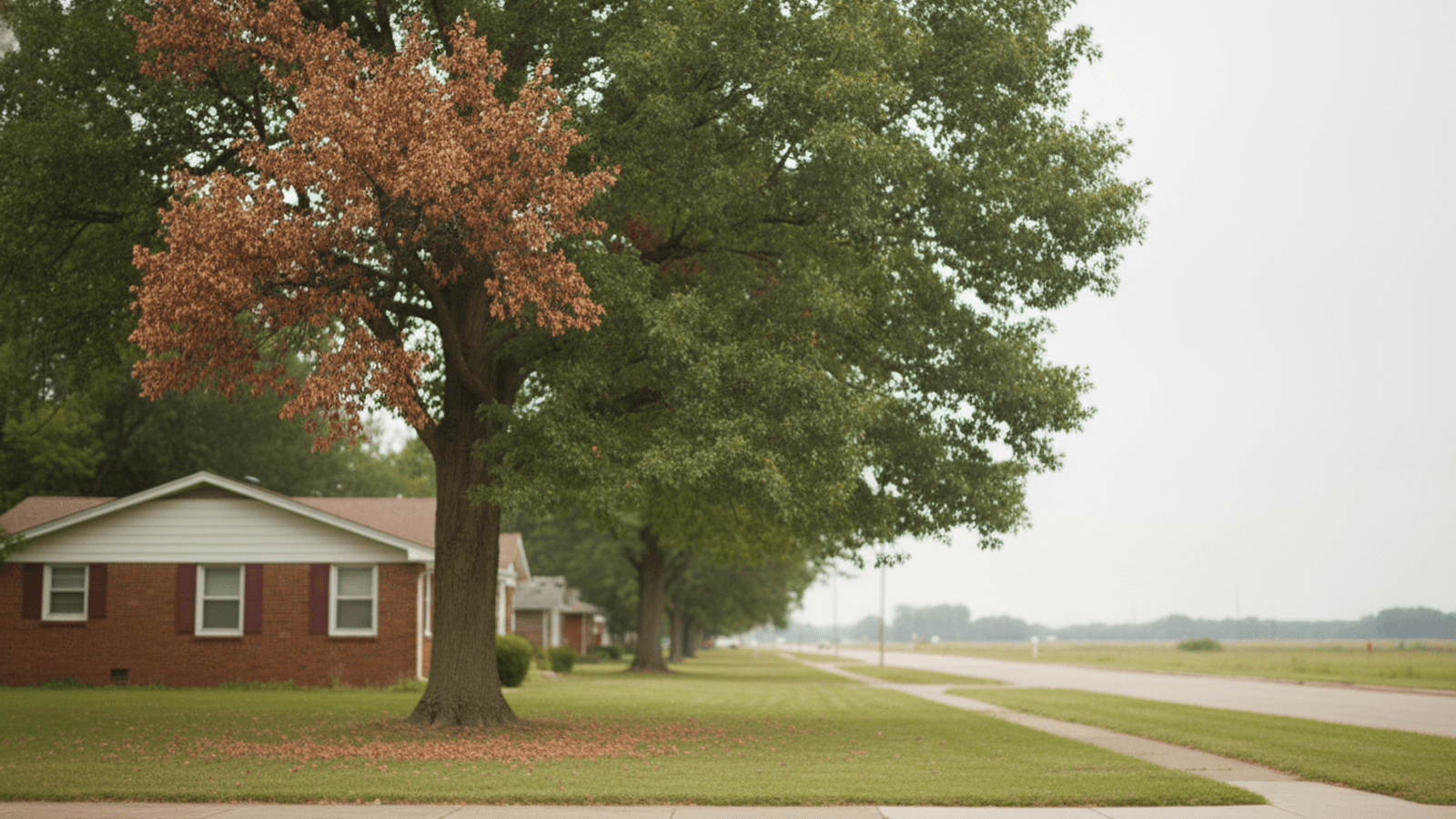
Oak wilt in Topeka cannot be confirmed from browning leaves, bare branches, or a photograph. Similar symptoms can have several causes. If an oak changes suddenly, avoid pruning it during April, May, and June. Keep people away from damaged limbs and arrange an on-site professional assessment.
Can visible symptoms confirm oak wilt in Topeka?
No. Browning foliage, thinning growth, bare branches, or decline in part of the canopy can justify a closer look, but none confirms oak wilt by itself.
K-State’s guide to tree and shrub problems in Kansas explains why careful diagnosis matters. Similar symptoms may come from different causes. Soil, drainage, moisture, light, and the tree’s immediate surroundings all belong in the assessment.
Both excessive and insufficient water can cause problems. A tree’s neighborhood or the age of a nearby house does not establish its age, growing conditions, or diagnosis.
A tree health assessment can examine the entire situation instead of relying on one leaf or photograph. The provider may consider recent changes, visible damage, root-zone conditions, drainage, and other stresses before discussing possible causes.
What does oak wilt look like, and how does it spread?
K-State publication MF3132, Tree and Shrub Problems in Kansas, is the Kansas source. It states: “Oak wilt, caused by Bretziella fagacearum (syn. Ceratocystis fagacearum), is an occasional problem on red oak in northeast Kansas and along the Kansas/Missouri border.” Topeka sits in northeast Kansas, so the geography applies. Occasional is not common. MF3132 also says: “Red oaks are more susceptible than white oaks to oak wilt.”
Infected trees “develop symptoms in late spring starting with a half leaf scorch, premature shedding of individual branches followed by a progressive wilt and decline.” “Brown streaks are present in the sapwood underneath the bark of flagging branches.” “Tree decline generally occurs within one season.” None of that confirms the disease from a photograph. “Testing to confirm oak wilt can be done at the K-State Plant Disease Diagnostic Laboratory.”
“Oak wilt is spread by sap beetles (aka picnic beetles) and from tree to tree through root grafts of infected oak trees.” Skipping cuts in the high-risk months addresses the beetle route. It does not stop root-graft spread.
MF3132 lists look-alikes: “Other problems that can be confused with oak wilt include environmental stress, poor site factors, Hypoxylon canker, and bur oak blight.” Bur oak blight is a named look-alike, not a diagnosis from brown leaves.
If a lab confirms oak wilt, MF3132’s management is: “Infected trees should be removed and root grafts broken.” “Healthy oaks near infected can be injected with a fungicide to protect against spread of the disease.” That is the publication’s option after confirmation, not a homeowner treatment and not a verdict on an unseen tree. “Wood from the infected tree should not be moved out of the area as it can carry the disease to new locations.” “Wood held for firewood should be tarped.” Do not haul suspect oak firewood to a new site.
What should you look for before requesting an assessment?
Look for changes that help a provider understand what happened and when. Useful observations include:
- where the change first appeared
- whether one branch or several areas are affected
- whether leaves dropped earlier than expected
- whether the trunk or major limbs were recently damaged
- whether drainage or watering conditions changed
- whether construction disturbed the surrounding soil
- whether nearby trees show similar changes
These details provide context, not a diagnosis. A bare branch is not automatically dead, and a crack that looks unchanged is not necessarily stable.
Clear photographs can document change over time. They cannot show every defect or confirm the cause of decline. Ask whether the provider recommends an on-site inspection and whether further diagnosis is appropriate.
When should you avoid pruning an oak in Kansas?
Avoid wounding or pruning an oak during April, May, and June. That is the oak-specific guidance in K-State publication MF3132.
K-State’s broader pruning guidance for trees and shrubs says deciduous trees are generally pruned before bud break, from late February through April. The oak exception narrows that general window because April is included among the months when oak pruning should be avoided.
That timing does not apply equally to every plant. Evergreens and flowering shrubs have different pruning considerations. The spring tree health checklist for Topeka covers broader seasonal inspection, while this guide addresses the oak-specific pruning exception.
When routine oak pruning can wait, discuss timing with the provider before approving the work. Pruning cannot guarantee that a tree will remain safe during a future storm.
What should you do after storm damage?
Stay clear of hanging branches, unstable damaged trees, and downed power lines. Electrical hazards belong with the utility. Do not approach the tree or attempt to cut branches under tension.
K-State’s guidance on pruning storm-damaged trees recommends professional assessment for dangerous damage. Some trees may be suitable for corrective work, while severe damage may require removal. Topping is not an appropriate repair.
Safety takes priority when damage creates an immediate hazard. That does not make every broken branch a do-it-yourself pruning job. A provider offering tree trimming in Topeka can assess the damaged area, access, nearby obstacles, and intended result before proposing a scope.
What happens during a professional assessment?
The provider should inspect the actual tree and its surroundings before reaching a conclusion. Ask what evidence supports the assessment and whether other causes could create the same symptoms.
Useful questions include:
- What parts of the tree and site were inspected?
- Could soil, drainage, moisture, light, or physical damage explain the symptoms?
- Is additional diagnosis needed before deciding on treatment or removal?
- Does the proposed work include hauling or stump work?
- What qualifications and insurance can the provider verify?
- Are any permissions needed for the proposed work?
- What does the written estimate include?
Topeka Tree Pro connects Greater Topeka homeowners with independent insured tree-service providers. The matched provider performs the inspection and any approved work. Homeowners should verify the written scope, qualifications, insurance, scheduling, and availability directly with that provider.
Does a declining oak need to be removed?
Not necessarily. Visible decline does not establish oak wilt or prove that removal is required. The decision should follow an assessment of the tree’s condition, surrounding hazards, site factors, and the homeowner’s intended result.
If removal is recommended, ask why it is preferred over pruning or continued observation. Request a written quote that states whether hauling and stump work are included. Tree removal service and stump grinding are separate parts of the project unless the written scope says otherwise. Grinding a stump does not mean the entire root system has been removed.
Frequently asked questions
Can oak wilt be diagnosed from a photograph?
No. A photograph can document visible symptoms, but similar symptoms may have different causes. An on-site assessment provides the context needed to decide whether further diagnosis is appropriate.
Is a bare oak branch definitely dead?
No. A bare branch alone does not confirm that it is dead or identify why it lacks foliage. Avoid cutting it based only on appearance, especially during April, May, or June.
When should oak pruning be avoided in Kansas?
Avoid oak pruning and other wounding during April, May, and June. This oak-specific guidance takes precedence over the broader pre-budbreak timing commonly used for deciduous trees.
Is a cracked branch safe if the crack has not changed?
Not necessarily. Appearance alone cannot confirm stability. Keep people and property away from the area and request professional assessment, particularly when the branch is hanging or under tension.
Does pruning eliminate future storm risk?
No. Pruning may address specific defects identified during an assessment, but it cannot guarantee that a tree or branch will withstand a future storm.
Who performs the tree work?
Topeka Tree Pro is a referral service. It connects homeowners with independent insured tree-service providers. The matched provider assesses the tree, supplies the written estimate, and performs any approved work.
Get help evaluating a Topeka oak
Do not assume the worst from one symptom, but do not ignore sudden decline or dangerous damage. Keep clear of hanging branches and downed lines, then request an on-site assessment.
Topeka Tree Pro connects homeowners across Topeka and Greater Topeka with independent licensed and insured providers. Call (785) 333-4052 to request an estimate. Confirm the provider’s estimate or visit fees, availability, qualifications, insurance, and the written scope.