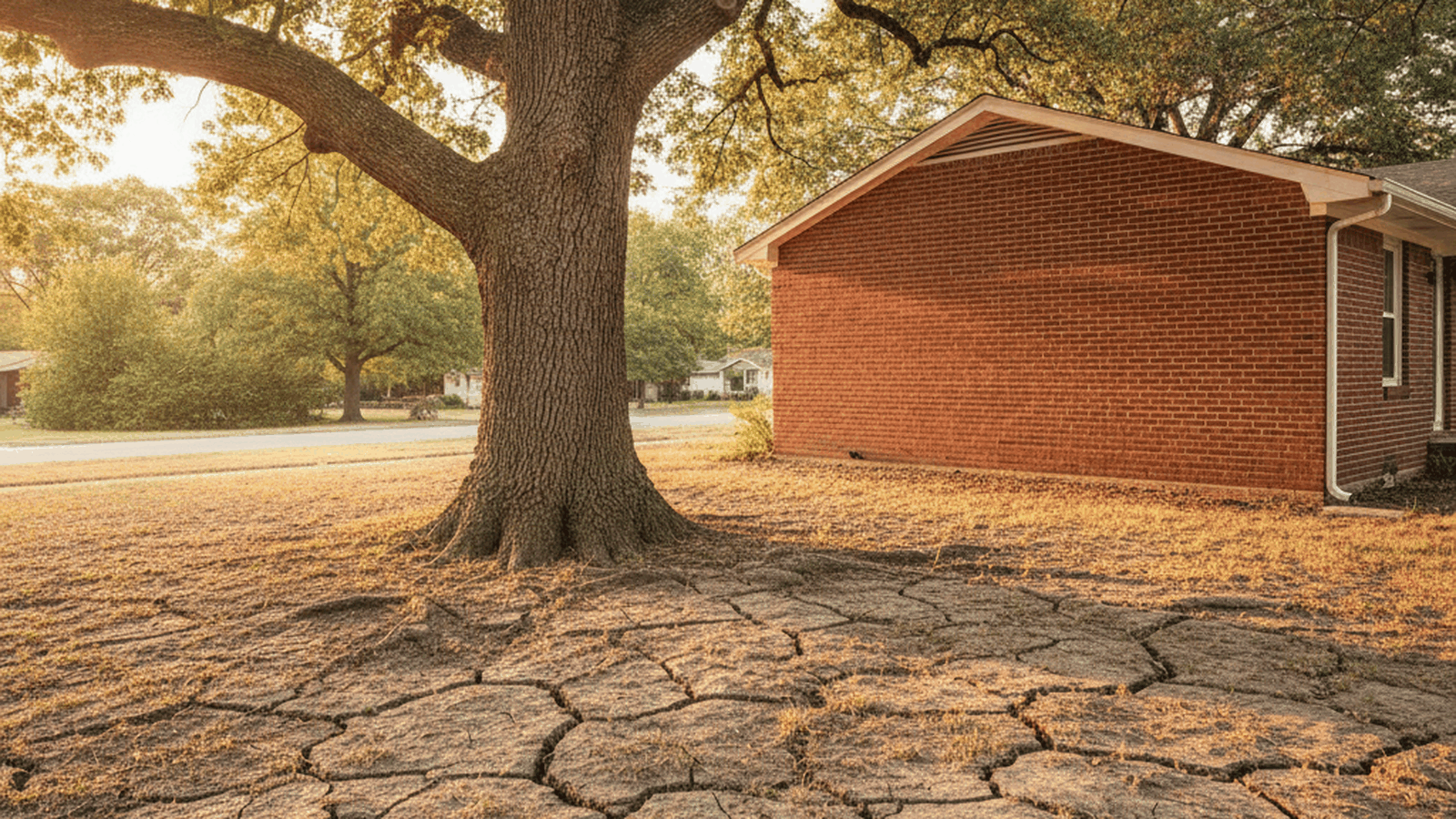
Tree roots can contribute to foundation damage when moisture changes affect shrink-swell soil, but a nearby tree does not prove the cause of a crack. Soil, drainage, weather, construction, and the tree’s actual root zone all matter. A structural professional should assess the building before tree work is treated as the fix.
The useful question isn’t only how close the tree is. Check site-specific soil, drainage, moisture patterns, foundation condition, and tree condition. County maps provide context, but they cannot diagnose one lot or establish rooting depth beneath a house.
Can tree roots damage a foundation in Topeka?
Tree roots can contribute, but the mechanism must be assessed on the property. In shrink-swell clay, changing moisture can move supporting soil. Roots may be one source of drying, while drainage, drought, leaks, irrigation, and construction can also affect moisture.
K-State Research and Extension puts the soil half plainly: “Clay soil has a high shrink-swell capacity.” During dry weather, the extension article says, “clay particles shrink and pull more tightly to each other. This shrinking is what leads to the cracks in the ground.”
Those same cracks show up in buildings. K-State’s wording is direct: “Foundations of homes are affected by the pressure that is exerted as the clay shrinks and swells. This pressure is great enough to crack foundations and basement walls, and move concrete sidewalks.”
A large tree can contribute to localized drying, but the presence of a tree does not establish why a particular foundation moved.
How tree roots actually cause foundation damage
A tree is a pump, and in a Kansas August it runs hard. Kenneth E. Tand, a practicing geotechnical engineer in Houston, Texas, describes the mechanism this way: “moisture losses at the surface of the leaves, termed transpiration, cause a suction that draws water up from the roots, through the trunk, and then through the branches to the leaves.”
The volumes get big. Tand writes that “It has been reported that large oak trees can suck more than 55 gallons of water a day from the subsoils during the dry summer months.” He also notes the obvious scaling factor: “In general, the larger the leaf area of the tree the more water is needed.”
Depth matters too. Tand puts the bulk of most root systems “within the upper 3 feet of the ground surface”, with rooting depth “more often 10 to 15 feet” where it goes deeper. That’s the same zone a residential footing cares about.
So the chain runs: canopy demands water, roots take it from the clay, the clay contracts, and the ground under the footing settles unevenly. Rigid concrete doesn’t bend. It cracks.
How much of Shawnee County sits on shrinkable clay?
The USDA Natural Resources Conservation Service maps soil properties across Shawnee County, including linear extensibility and shrink-swell potential. Those maps show that conditions vary, but county acreage cannot tell you what supports one foundation.
Use NRCS mapping as a screening tool. A qualified structural or geotechnical professional can evaluate the actual soil, drainage, fill, moisture, and foundation conditions when a crack or movement needs diagnosis.
Which mapped soils deserve a closer look?
The NRCS survey distinguishes map units by properties such as clay content and linear extensibility. Some mapped units have greater shrink-swell potential than others, but a mapped boundary or published profile does not prove the soil conditions directly beneath a footing. Soil may also have been disturbed, filled, compacted, or affected by drainage changes.
Use the map to frame questions, not to name the cause. Ask a structural or geotechnical professional whether site-specific investigation is needed before deciding that a tree or named soil series caused the movement.
How do I find out what my own lot sits on?
Look up your address, because you can’t guess it from your street or ZIP code. Soil boundaries cut across neighborhoods, and two houses on the same block can sit on different map units.
The free tool is the NRCS Web Soil Survey. Draw a box around your parcel and it reports the soil series under it. That single lookup tells you more about your tree-and-foundation risk than any rule of thumb about distance.
If the survey shows higher shrink-swell potential, treat that as a reason to investigate site moisture and drainage, not as proof of the soil beneath the footing or the cause of a crack. A tree health assessment addresses the tree’s condition; a structural professional must evaluate the building.
What does the damage look like when it is soil movement?
Foundation movement can appear as diagonal cracks or doors and windows that begin sticking, but none of those signs identifies the cause by itself. Similar symptoms can reflect soil moisture, drainage, construction, plumbing, or other structural issues. A structural engineer or qualified foundation professional should evaluate the pattern and site conditions.
Tand’s Houston, Texas investigation database is worth quoting because of what it’s a database of. He found that “pre-existing or planting of new trees next to buildings was the major contributing factor at more than one half of the Houston sites.” Those are buildings he was called out to because they were already distressed, not a survey of ordinary houses.
He’s equally clear about scale. Of the large settlement and heave figures in his case histories, Tand writes that “These large magnitudes of foundation movement are exceptions, not common occurrences.” Those case histories do not establish how often tree-related soil movement occurs among ordinary houses.
Two more caveats. Texas isn’t Kansas, and Tand says so himself; his numbers describe Houston soils and Houston construction. And a tree crew can’t read a crack. That’s a structural engineer’s job, or a foundation contractor’s.
If what’s lifting is a public sidewalk rather than your house, that’s a different question with a different answer. We covered it in tree roots lifting a Topeka sidewalk, including the City’s 50/50 program.
Does removing the tree fix it?
Removal can change site water use, but it does not guarantee that soil movement stops. In some conditions, soil may take on more water after a tree is removed, so that possibility should be evaluated before removal.
Here’s the trap. Tand’s Houston case histories record that “The trees often have desiccated the clays to deep depths, and significant heaving occurs after their removal.” Stop the pump and the clay starts taking water back on.
K-State describes that swell side from the Kansas end. Watering during drought, the extension article says, “prevents the shrinking that, at some point, will swell again and place pressure on the foundation.” Same clay, same pressure, opposite direction.
Put those two together and the honest read is that cutting a tree down to solve a cracked foundation is a decision with two risks, not zero. If a crack is what’s driving the question, get the structural opinion first and let it inform whether tree removal is part of the answer. Nobody in the tree trade should be making that call for you.
What a homeowner can actually do about it
You cannot identify the right moisture response from a crack alone. Both excessive and insufficient water can create problems, so drainage, irrigation, leaks, and drought conditions need to be considered together.
K-State’s Johnson County article, Clay Soil: It shrinks and swells, gives the drought-season version: “during periods of drought you will hear recommendations to water the soil a foot or two around the home. This additional moisture prevents the shrinking that, at some point, will swell again and place pressure on the foundation.”
The same article attaches a warning that has to travel with it: “But never add soil around the foundation to fill in the cracks. Added soil will result in more pressure being placed on the foundation as the clay expands, resulting in increased damage.” Water the ground. Don’t fill the gap with dirt.
Do not use tree trimming to repair the foundation based on a crack in the foundation, the home’s age, or a neighborhood pattern. An arborist consultation can examine the tree, root area, site conditions, and intended result. A structural professional should assess the foundation and recommend repairs. Our guide to how a tree gets its risk rating explains the separate purpose of a tree risk assessment.
Frequently asked questions
Can tree roots grow through a concrete foundation?
Roots may enter existing openings or joints, but that does not show what caused a crack in the foundation. Soil movement, drainage, construction, plumbing, and other structural conditions may contribute. Ask a structural professional to assess the crack and site before deciding that roots or moisture caused it.
How much water does a large tree use in summer?
Kenneth E. Tand, a geotechnical engineer working in Houston, Texas, writes that large oak trees have been reported to draw more than 55 gallons a day from the subsoil during dry summer months. He also notes that water demand scales with leaf area, so canopy size matters more than trunk size when you’re judging how hard a tree is pulling.
Should I cut down a tree that’s close to my house?
Not on the strength of a crack alone. Tand’s Houston case histories record significant heaving after mature trees are removed, because the dried-out clay takes water back on and swells. Removal trades one direction of soil movement for the other. Get a structural engineer’s read before a tree crew touches it.
How do I keep clay soil from shrinking near my foundation?
K-State Research and Extension describes watering near a home during drought as one way to limit drying in shrink-swell clay, and it warns against filling visible foundation gaps with added soil. That general guidance is not a diagnosis or a fixed watering plan. Account for drainage, rainfall, irrigation, and actual site conditions before adding water.
Which Topeka soils are the worst for this?
NRCS maps some Shawnee County soil units with higher shrink-swell potential than others. The map does not diagnose your parcel, the material supporting the foundation, or the cause of movement. Look up the address in Web Soil Survey, then ask a qualified professional whether site-specific investigation is needed.
Who should I call about a cracked foundation?
A structural engineer or a foundation contractor, not a tree service. Diagnosing what a crack means and what it needs is outside what a tree crew can honestly assess. Once you have that opinion, an arborist can tell you what the trees on the lot are contributing and what the canopy needs.
Where a tree crew fits in
The order matters here. Structural questions go to a structural engineer, Web Soil Survey provides mapped soil context, and tree questions go to an arborist. If tree work is recommended, Topeka Tree Pro can connect you with an independent insured provider serving Greater Topeka. Ask the provider to assess access, obstacles, tree condition, written scope, qualifications, and insurance. Call (785) 333-4052 to request an estimate.