The first sign is rarely a root you can see. It is a toilet that drains slow on a Highland Park morning, a gurgle in the tub when the washer dumps, or a bright green stripe in the lawn over a silver maple that looks fine from the street. Tree roots in a sewer start at a wet joint, not at the trunk. Fine roots follow leaking wastewater into clay tile or old fiber pipe, then thicken until the lateral cannot carry the house. A camera tells you what is in the pipe. Only after that picture do you decide whether the tree in the yard stays.
How roots find a clay or Orangeburg joint
Roots do not punch through sound pipe. They find moisture at a failed joint, a crack, or a collapsing fiber wall, then follow the water in.
Clay tile laterals under 1880s-to-1950s housing in Potwin, Oakland, North Topeka, and Highland Park were laid in short sections. Each joint was packed, then freeze-thaw and expansive clay moved the ground until the packing opened. Wastewater is warm and wet. A hairline leak at one of those joints is a drip line the tree can smell. Fine roots enter. Once they are inside the flow, they thicken. The mass becomes a net, then a plug. Every fixture in the house starts to talk to every other fixture.
Orangeburg, the bituminized fiber pipe used in a lot of mid-century laterals, fails a different way. The wall delaminates. Roots do not need a cracked bell. They walk into the layers and fill the bore. Cast iron can rot at the invert and open the same invitation. Newer PVC along the Wanamaker corridor, Westboro, Wakarusa, Silver Lake, and Rossville is smoother and the trees are younger, so the classic “roots ate the whole run” job is less common until a joint leaks or the line is damaged. The mechanism is the same. Water leaves the pipe. Roots follow it home.
Species is a clue, not a verdict. Silver maple, cottonwood on the Kansas River bank at NOTO, willow, poplar, and elm are aggressive water seekers. An Osage orange hedge on an Osage County property line will do the same thing to a rural service line if one is leaking. A bur oak over a Highland Park garage can sit above a clean lateral. A small crabapple can sit over a failed one. The camera reads the pipe. The tree from the street does not.
Northeast Kansas weather feeds the problem without putting the first root in the joint. Ice loads limbs until unions fail. Spring straight-line wind and hail do the same. A tree already feeding on a leaky lateral is often the one that drops wood first, because the root plate has been working two jobs: holding the stem up, and mining the sewer. Storm-damage cleanup after ice is a separate call from the plumber. The two jobs show up on the same lot more often than people expect.
Inside the house, a single slow kitchen sink is usually a local clog. Roots in the sewer show up as more than one drain acting up at once, a sewage odor at the lowest fixture, a gurgle when another fixture dumps, sewage in a basement floor drain, or a lush stripe in the yard over the run to the street. None of those prove a species. They prove the line is not carrying what the house is sending.
Do not feed a store-bought snake into the main and hope. Ground-level raking and small hand pruning are the only yard work this site will cheer for. A cable in a root mass binds, kinks, and stays in the pipe. That is plumber territory.
Camera, cut, and whether the tree has to go
A camera down the cleanout is the only honest next step once more than one drain is slow. Cutting without a picture is guessing: roots, a belly, grease, a break, or a collapse can look the same from the bathroom.
Mechanical cutters and jetters clear the bore. They restore flow. They do not seal the joint that invited the roots. The leak is still there, so the tree sends another flush of fine roots through the same opening. A cut-only job can become a regular plumber visit for that reason. Recurrence is the mechanism, not a mystery about how fast a particular species grows.
Closing the invitation is pipe work: replace the lateral, or line it so the joints are no longer open. Relining can leave a healthy tree in place when the excavation is limited. Open-cut replacement on a tight Potwin or Oakland lot is a different story. There may be no room to trench around a mature stem, a sidewalk, and a city right-of-way strip. On those lots, whose tree it is is already a live question before anyone talks about the pipe.
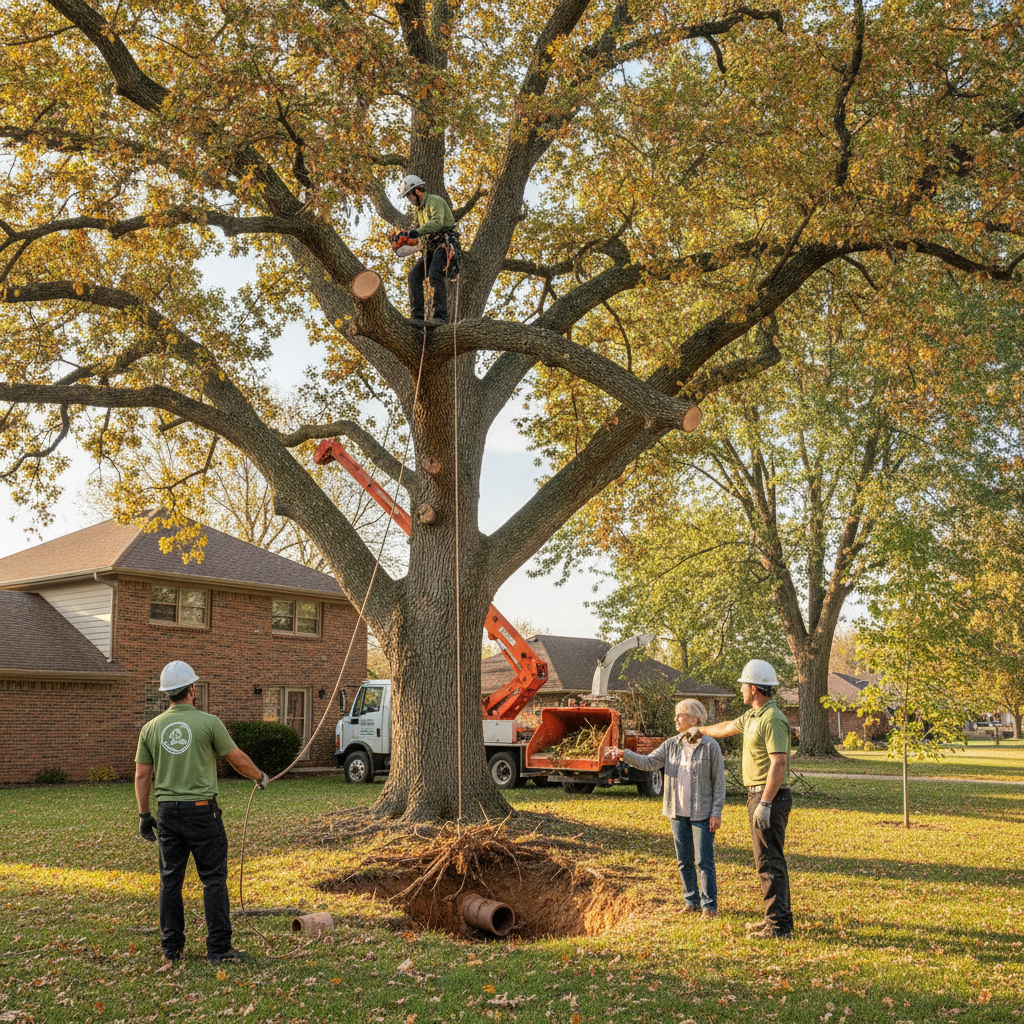
The tree has to come out when the stem is already a failure risk on its own, when the roots have crushed the pipe and the trench has to go through the root plate, or when keeping the tree means you will cut the same mass forever. A co-dominant union with included bark, a lean that opened after ice, or decay in the lower stem are reasons an on-site assessment would look hard at removal even if the sewer were perfect. No living tree can be certified safe. An assessment names visible concerns and ways to reduce risk. It does not promise the maple will stay up.
Tree trimming and pruning can take weight out of a cracked union. It does not starve roots in a sewer. The prize in that pipe is wastewater, not rain in the crown. Topping is worse: it forces weakly attached sprouts and leaves the leak untouched. If the camera and the trench plan say the stem has to go, that is tree removal, not a plumbing add-on. Stump grinding after removal is a separate scope, and a grinder next to a shallow lateral is a utility problem, not a weekend rental.
Ask for the name of the person who will actually look at the tree, then check that name in the International Society of Arboriculture’s directory. The ISA Certified Arborist credential belongs to a person, not to a company and not to this brand. Kansas has no statewide tree-service licence and no statewide general contractor licence. Licensing here is local. The City of Topeka licenses contractors who work inside city limits. Most of the smaller towns and counties in this footprint license nothing at all. Confirm a city licence with the City of Topeka if the work is inside Topeka. Confirm current proof of insurance with the matched provider before work begins.
Chemical root killers get sold as a pour-down fix. They are a plumber and a sewer-utility question, not a weekend experiment. A product that travels downstream belongs to the treatment plant’s rules. It also does not close the joint. Mechanical cutting clears the bore. Lining or replacement stops the invitation. There is no honest dollar figure on this page for either job, because the plumber’s number and the tree work are different scopes. What moves both: length and depth of the run, whether it sits under a driveway or a mature oak, open cut versus lining, how tight the lot is, how much wood has to leave if the tree comes out, and whether stump work is in the same visit.
| Path | What changes | What stays |
|---|---|---|
| Cut the roots only | Flow returns for a while | The leak, so roots come back |
| Line or replace the lateral | Joints close | The tree, if the trench can miss the stem |
| Take the tree and leave the pipe | New roots stop feeding that leak | Open joints, until a plumber closes them |
| Take the tree and replace the line | Both problems | A hole in the yard, then a replant if you want one |
On a Wanamaker-corridor lot with room for a mini-excavator, lining or a short open cut can spare a young shade tree. On a 1920s Oakland lot, the same diameter stem may sit over the only path to the main. Rural acreage in Auburn, Berryton, Carbondale, Overbrook, or out toward Alma often has a longer private run and an Osage orange or volunteer timber line instead of a street tree. There is no municipal forestry to call out there. The camera still comes first.
Who owns the lateral in Topeka
The city’s sewer main sits in the street or the alley. The pipe from the house out to that main is the private lateral, and that is the run that usually holds the roots. The City of Topeka is who defines, for a given address, where their main stops and the private pipe begins. Confirm that split before you assume the tree and the blockage are both yours to pay for. The boundary is often not where a homeowner thinks the property line is, especially on tight lots where a sidewalk, a planting strip, and a mature street tree sit in a few feet of dirt.
A tree in the city right-of-way or on other city property is not the homeowner’s to cut. The City of Topeka Forestry Division is the authority to confirm the tree’s location and any permit need with before anything is scheduled. Roots do not respect that line. A city tree can find a private lateral. A yard tree can find a joint under the parking. The plumber maps the pipe. Forestry maps the stem if it is in the right-of-way.
Outside the city the picture changes again. Holton and Oskaloosa have old canopy around a county-seat square and farmland beyond it. Perry, Ozawkie, and the Jefferson County shoreline add a different owner on Corps of Engineers land, which is not a backyard sewer question so much as a reminder that “who owns this tree” is a real sentence in this metro. Wabaunsee County and St. Marys run to windbreaks and cedar. On acreage there may be no city main at all. A private tank and a private line are a different system, and a thirsty hedge row can still find a leak.
If a tree job goes wrong, the Kansas Attorney General’s office is where a consumer complaint about a contractor goes. Look up the current complaint route on the Attorney General’s website. Do not treat an ISA credential as a licence. It is a named person’s credential you can check. Do not treat a city contractor licence as proof the person in the tree holds that credential. Ask who will be on the property, then check both.
How serious are tree roots in a sewer?
Serious enough to back sewage into the lowest drain, and, if the mass keeps expanding, to split a clay joint or crush a fiber pipe. A first-time cut can restore flow. A collapsed run is a trench. The damage is to the pipe first. The tree becomes part of the job when the roots have welded themselves to that failure, or when the stem is already a risk on its own.
What dissolves tree roots in a sewer?
Nothing a homeowner should pour down a toilet. Chemical root killers are a plumber and utility question because they travel to the treatment plant and they do not repair the joint. Mechanical cutting clears the inside of the pipe. Lining or replacement is what stops the next flush of roots. Ground-level cleanup in the yard does not reach the lateral.
How much does it cost to fix tree roots in a sewer?
The plumber prices the pipe. An independent insured tree-service provider prices the tree if it has to come out, and you confirm that number with the matched provider. Length, depth, paving, access between houses, and whether a mature stem sits on the trench line move both figures. A cut-only visit is a different job from an open-cut replacement under a Potwin driveway. There is no flat rate on this page because those jobs are not the same work.
How fast do tree roots grow in sewer pipes?
Once a root is in wastewater, it thickens through the growing season. Fine roots can re-enter a still-leaking joint after a cut because the invitation never closed. There is no honest speed in feet or weeks to print. Recurrence after a cut-only job is the practical measure: if the leak remains, the tree will find it again.
When to call us
When the camera shows roots tied to a tree that may need to come down, or when ice has already dropped the maple sitting on a leaking lateral, that is insured tree-service work, not a weekend with a saw. Topeka Tree Pro matches Greater Topeka property owners with independent insured providers; confirm current proof of insurance with the matched provider before work begins. Call us at (785) 333-4052.