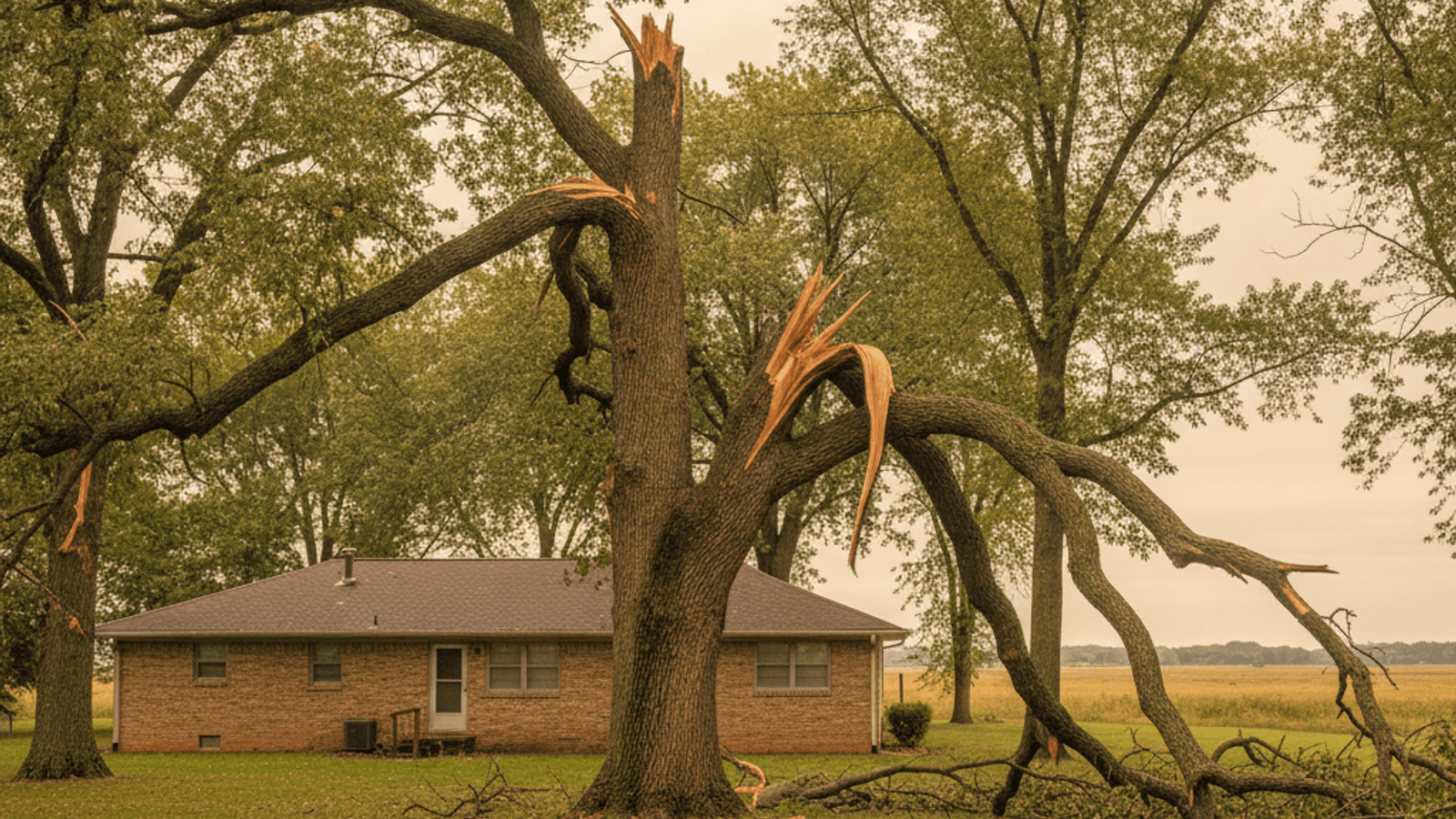
No. After a Kansas storm, do not cut every main branch back to a stub. K-State Research and Extension in Shawnee County calls that topping, and it “is not a recommended pruning procedure.”
New shoots will usually come from those stubs. They are not as firmly attached as the original branches and are more likely to break in the next storm. The tree also spends energy growing that flush of wood, which leaves less energy to fight disease and insects.
If a limb is hanging, under tension, or on a line, stay clear. That is a hazard, not a topping job. Call (785) 333-4052 to be matched with an independent insured provider, and call the utility for electrical hazards.
What is tree topping?
The Shawnee County handout defines it in one sentence: “Topping, where all the main branches are cut and there are only stubs left.”
It is not the same as taking one broken limb back to the next sound branch or to the branch collar. It is not a height trim that keeps the tree’s structure. It is cutting the scaffold back and leaving stubs.
Why do people ask for it after a storm?
The yard looks wrecked. Small twigs and leaves cover the lawn. One or two large limbs may be gone. The first impulse is to shorten everything that’s left so the next wind can’t grab it.
K-State’s same handout says the mess often looks worse than the tree is. Trees “may intentionally shed small clusters of leaves and twigs to lighten the overall weight of their larger branches.” A tree that lost only leaves and twigs “will make a full recovery” if you water it through drought. That is not a reason to cut the crown off.
What should be cut instead?
Prune broken branches “back to the next large branch or to the trunk.” If the cut is at the trunk, “do not make the cut flush with the trunk but rather cut at the collar area.” A flush cut makes a larger wound.
Large limbs come off in stages. Trying to take a heavy limb in one cut “will often break before the cut is finished and strip bark from the tree.” The handout walks the three-cut method: an undercut about 15 inches out, a top cut two inches farther out so the limb breaks away, then a final cut at the collar to remove the stub.
Do not coat the wound. “Do not apply any products over the cut areas.” Sealants, including products made for trees, “increase the amount of time until the tree heals.”
When is removal the answer instead of pruning?
If the bark is split and the cambium, the inner trunk, is exposed, or the main trunk has split, “the tree will not survive long term and should be removed.”
If so many limbs are broken that the tree’s form is ruined, “replacement is the best option.” Topping is not the salvage method for that tree.
Age matters. “Middle-aged or younger, vigorous trees can have up to one-third of the crown removed and still make a surprisingly swift comeback.” Older trees “are less resilient,” and removal “may be the safest option for severe damage.” That is a maybe, decided on the actual tree, not a Topeka-wide rule.
Is this the same as commercial “no topping” language?
Property managers already have a bid-language answer on commercial tree service in Topeka. This page is the homeowner storm question, sourced to the Shawnee County storm-pruning handout, not to ANSI A300.
If a provider offers “crown reduction” instead of topping, ask them to describe the finished cuts in writing. The handout’s recommended finish is a cut to the next large branch or to the collar, not a row of stubs.
What should you do in the first hour?
Stay out from under the tree “until it is determined to be safe.” Watch for downed lines and hanging branches. Downed limbs “may be under compression.” Cutting a limb under compression can release stored force.
Electrical hazards belong with the utility. Dangerous tree damage belongs with a qualified assessment. Emergency tree service and storm damage cleanup are the matching service pages. For timing that is not a hazard, see when to trim trees in Kansas.
Topeka Tree Pro connects Greater Topeka homeowners with independent insured tree-service providers. Call (785) 333-4052 to request an estimate, then confirm insurance, written scope, and availability with the matched provider.
Is topping ever a good idea on a Topeka shade tree?
No. Shawnee County’s K-State handout says topping is not a recommended pruning procedure. New growth from stubs is not as firmly attached and is more likely to break later.
Can I just shorten the whole crown so the next storm misses it?
That is topping if you cut the main branches to stubs. The handout’s alternative is to prune broken wood back to the next large branch or the collar, or to remove the tree if the trunk is split or the form is ruined.
What if only one big limb came down?
The handout says a tree that lost one or two major limbs, or many small limbs, may still be salvageable. Have a provider assess the actual tree before anyone cuts more.
Should I put pruning sealer on the wounds?
No. The handout says not to apply products over the cuts, including sealants made for trees. Those products increase the amount of time until the tree heals.
Who should I call if a limb is still hanging?
Stay clear. If it involves a power line, call the utility. For the tree itself, request a matched provider at (785) 333-4052 and ask for an on-site assessment before any cutting.