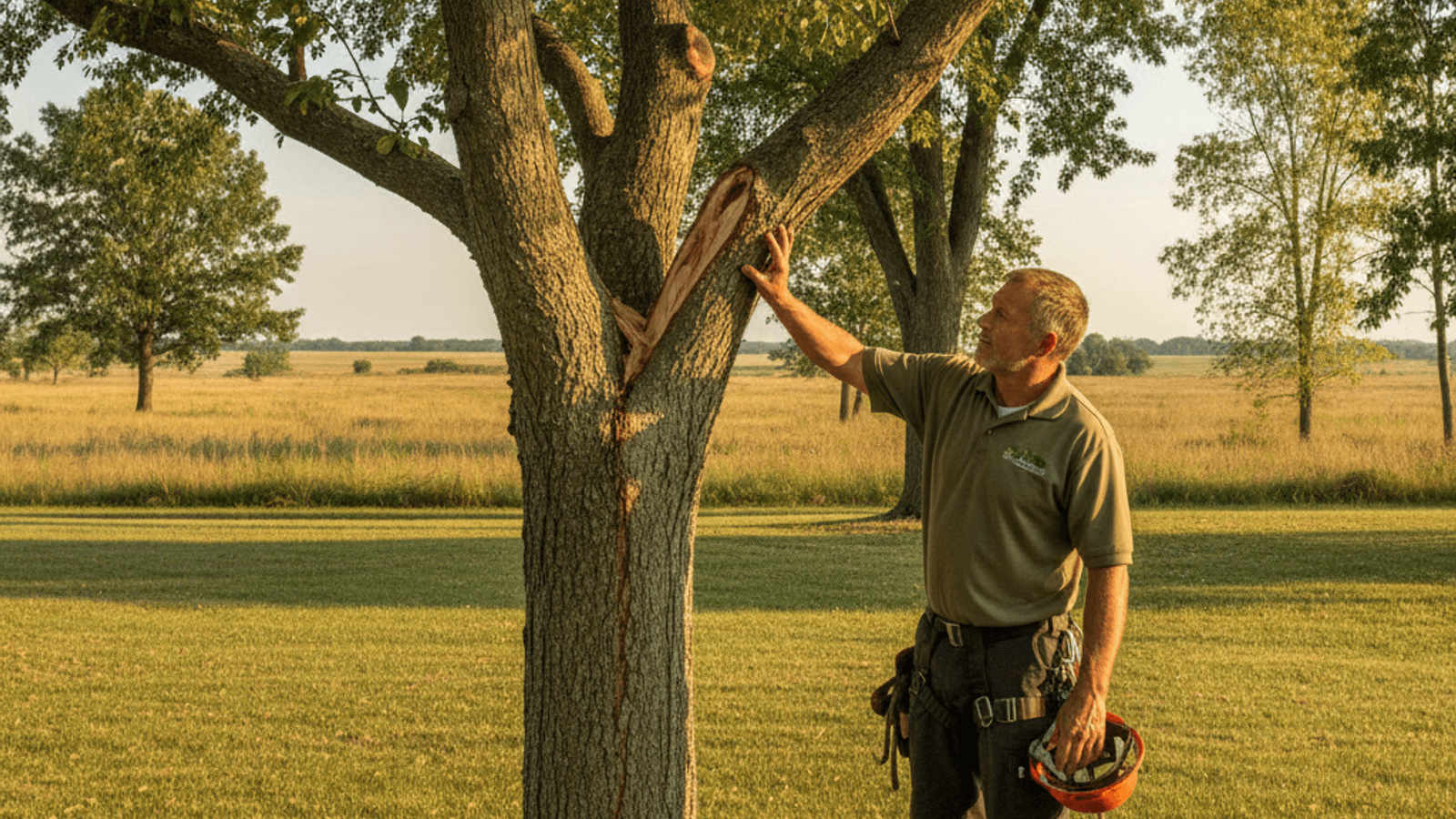
Bradford pear tree splitting can happen when weak branch unions cannot carry wind, ice, or canopy load. If your Topeka tree has a crack, hanging limb, or shifted stem, keep clear and request a professional assessment. The provider can compare the tree’s structure, surroundings, and practical options.
Why Bradford pears split so easily
The problem isn’t bad luck. It’s baked into how the tree grows. A Bradford pear pushes out branches quickly from a small number of points low on the trunk, and those branches tend to grow at narrow, upright angles instead of spreading out with wide, strong unions. Where two or more limbs meet at a tight angle, bark gets pinched between them instead of fusing into solid wood, a condition arborists call included bark. That seam never bonds the way healthy wood does, so it stays the weakest point on the tree for its entire life.
Bradford pears can develop several narrow-angle unions within the same canopy. Each union needs separate evaluation because reinforcing one weak point does not resolve problems elsewhere in the tree. The number, position, and condition of those unions help a provider compare pruning, support, and removal options.
As the canopy grows, added weight and wind exposure can place more stress on weak unions. Age alone does not determine whether an individual tree is stable, so the branch structure and current condition still need assessment.
What Topeka’s weather does to speed up the failure
Wind can move major stems independently, while ice can add weight across a dense canopy. Either load may expose an already weak union. Weather alone does not reveal whether a specific tree will fail, so visible cracks, hanging branches, and shifted stems should be assessed based on their actual condition and surroundings.
Signs your Bradford pear is at risk before it fails
Visible symptoms can identify a reason for closer inspection, but one symptom cannot diagnose the tree or predict failure. Observe only from stable ground and keep clear of hanging branches or an unstable tree.
Tight V-shaped unions may indicate that bark is trapped between major stems.
A denser or unbalanced canopy may change how wind and weight act on the unions.
Cracks or open seams need assessment for their depth, movement, and surrounding wood condition.
Leaning or shifted limbs may indicate damage that has not been evaluated.
Request a tree health assessment so a qualified provider can examine the tree, nearby obstacles, and possible consequences of failure.
Can a split Bradford pear be saved with cabling and bracing?
Sometimes. Cabling and bracing may be considered when a provider identifies a supportable union and finds that the surrounding trunk, stems, and root area warrant preservation. The assessment should cover every major union rather than treating one visible crack as the entire problem.
Ask what the proposed system is intended to support, which defects it cannot address, and what follow-up inspections the provider recommends. Healthy-looking foliage does not prove that the underlying structure is sound.
When removal is the right call
Tree removal may be recommended when the provider finds damage or instability that cannot be managed acceptably around a house, driveway, fence, or other target. Species and branch form provide context, but the decision should reflect the individual tree’s condition, access, obstacles, and intended result.
If removal is recommended, ask the provider or a local nursery about replacement options suited to the planting space. Soil, drainage, moisture, light, mature size, and clearance from structures all belong in that decision. No replacement species is appropriate for every Topeka property.
If a limb has fallen onto a roof, fence, or vehicle, keep people away and request emergency tree service. Do not work beneath a hanging branch or cut wood under tension. Stay clear of downed power lines and contact the utility for electrical hazards.
What removal and replacement actually involve
The removal method depends on access, obstacles, tree condition, and the intended end result. Ask whether the written quote includes removal, hauling, and stump grinding. Stump grinding reduces the visible stump and root crown, but it does not remove the entire root system.
Before planting a replacement, have the planting area evaluated for soil, drainage, moisture, light, available space, and nearby structures. Those site conditions matter more than a county-wide assumption about what grows best.
An estimate depends on the provider’s assessment of the tree, access, obstacles, and requested scope. Use the questions in what affects a tree removal estimate in Topeka to compare written quotes. Confirm whether each quote includes removal, hauling, stump work, and site cleanup.
Before hiring, ask the provider for proof of insurance, relevant qualifications, and any permissions the proposed work requires. Verify those details directly rather than assuming they apply to every property or job.
Frequently asked questions
How do I know if my Bradford pear needs to come down or can be saved?
You cannot determine that from age or one visible union alone. A provider should assess the tree’s structure, roots, damage, access, nearby obstacles, and the consequences of failure. Ask for the reasons behind any cabling, pruning, or removal recommendation.
What should I consider when replacing a Bradford pear?
Start with the actual planting site. Ask about soil, drainage, moisture, light, available space, mature branch spread, and clearance from structures. A local nursery or qualified tree professional can help compare species after reviewing those conditions.
The Kansas Forest Service’s 2026 Callery pear buyback has already run. Bradford was an eligible cultivar, and the offer was a free native replacement tree, not money for removal. Don’t treat that round as an open signup. No later event is posted, so there’s nothing to sign up for now. The program page is still posted and worth watching. Our tree planting cost guide for Topeka covers that buyback in past tense. This page stays on the split-versus-removal question.
Will homeowners insurance cover damage from a Bradford pear limb?
Coverage depends on your policy, the event, and the insurer’s review. Contact your insurance company for an answer tied to your property and coverage. Photograph visible damage from a safe location and keep any professional assessment or written scope you receive.
Topeka Tree Pro connects Greater Topeka homeowners with independent insured tree-service providers. Call (785) 333-4052 to request an estimate, then verify availability, qualifications, and the written scope directly with the matched provider.