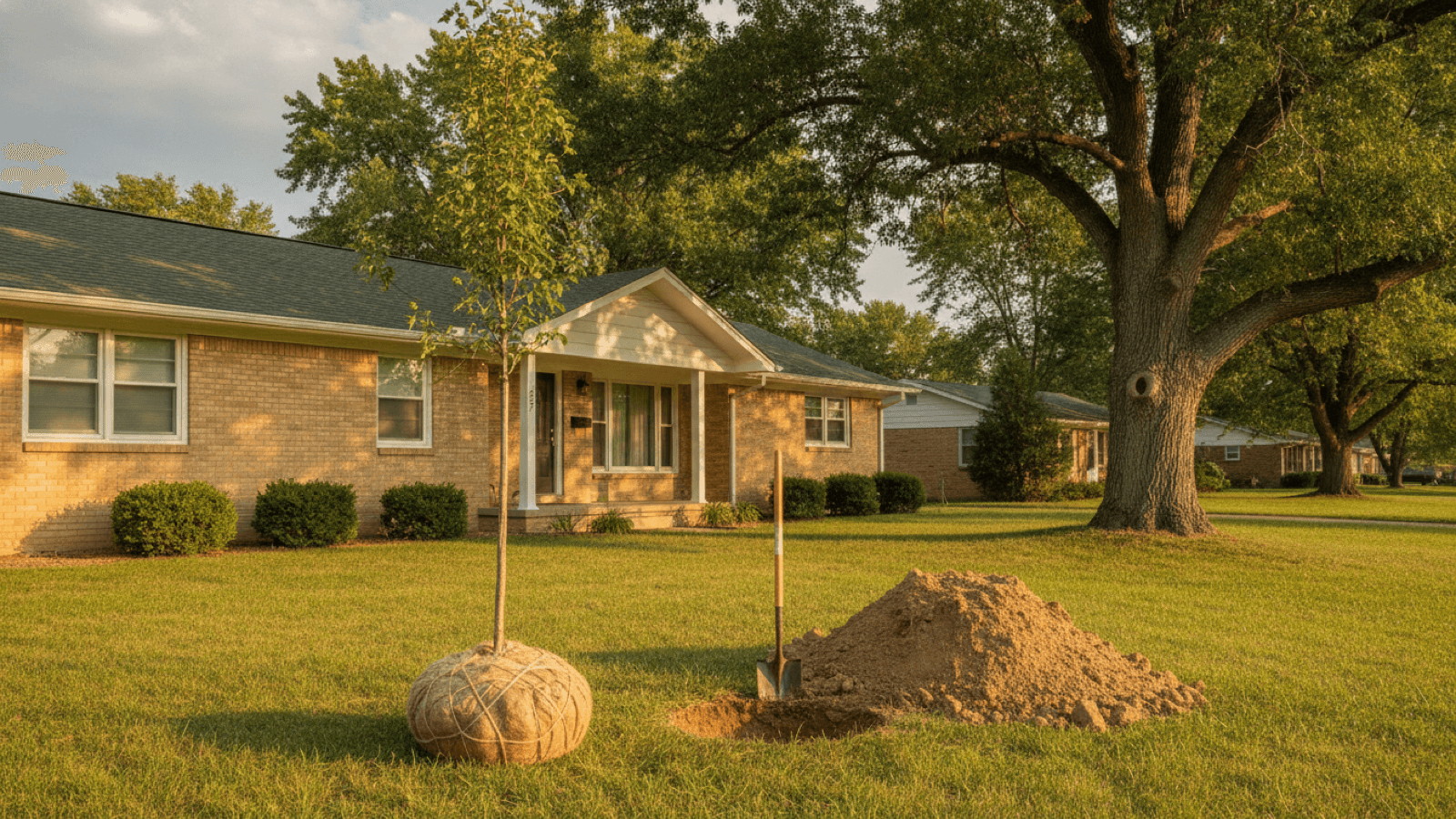
Tree planting cost in Topeka depends on the tree, delivery access, site preparation, installation, and follow-up care. A provider needs to inspect the property before giving a reliable estimate. Ask for each part in writing so you can compare the same scope across quotes.
What does tree planting cost in Topeka?
Nobody can price it off a photo. Ask a nursery or planting contractor for an itemized quote before you order stock, and make them break it into parts.
A useful quote answers all six of these:
| Quote item | What to confirm |
|---|---|
| Tree stock | Species, container type, trunk size, and current condition |
| Delivery | Access through gates, slopes, steps, or narrow side yards |
| Site preparation | Existing stump, buried roots, drainage, and disturbed soil |
| Installation | Planting, staking decisions, mulch, and initial watering |
| Follow-up care | Watering instructions and responsibility after installation |
| Permission | Whether the location is private property or City right-of-way |
Split out that way, two quotes are actually comparable, and you can see what you’re paying for the tree versus the work around it.
If an existing tree must come out first, keep removal, hauling, stump work, and planting on separate quote lines. A 7-12 inch trunk diameter is listed at $500-$2,000 and a 13-20 inch trunk diameter at $900-$3,000 in Wellnitz Tree Care’s undated cost guide. Stump grinding is listed there at $175-$500 or more, separate from removal. The guide’s publication date isn’t established, and those figures are that provider’s published illustrations, not Topeka Tree Pro prices, a Topeka average, or verified 2026 rates. Access, condition, obstacles, cleanup, hauling, and requested stump work still change a current bid. Planting itself stays a nursery or planting-contractor quote. Our Topeka tree removal cost guide explains how to compare that written scope before requesting a separate planting proposal.
Why the cheapest trees in Kansas are not available this fall
The Kansas Forest Service conservation program has no Fall 2026 sale. Its posted conservation tree schedule says, “No Conservation Tree Sale due to construction.”
Spring 2027 sales are scheduled to resume with bareroot stock only. Containerized evergreen conifers won’t be available during that season. Fall 2027 is expected to offer containerized deciduous trees and shrubs. The posted schedule says conifers won’t be available then either.
That schedule may affect which conservation-program stock is available. It does not establish what a nursery or planting provider should charge for a yard tree.
If you’re replanting a shelterbelt rather than a yard tree, our guide to windbreak trees in Topeka and Kansas works through what the closure means for a whole row.
Who the state’s seedlings are actually for
Even in a normal year, those seedlings were never meant to be your front-yard shade tree. The Kansas Forest Service sells them for conservation plantings, and it lists what that means: woodlots, windbreaks, educational purposes, riparian and streambank vegetation, Christmas tree production, wildlife enhancement, and timber production.
One replacement tree in a front yard isn’t on that list. For that you’re comparing local nursery stock and installation quotes like anyone else.
Pick the species to fit the property, not the other way around. The Kansas Forest Service and K-State Research and Extension both publish recommended-species guidance for this state, and it’s better than anything a national list will tell you. An arborist consultation in Topeka can measure the space you actually have before you buy.
Kansas gave away a free tree for one specific removal
The Kansas Forest Service’s Callery Pear Buyback Program offered one free native tree per household to any Kansas resident who’d removed a Callery pear. Its page names the cultivars too: ‘Bradford’, ‘Cleveland Select’, and ‘Aristocrat’.
Proof was straightforward. Two photos, one of the tree standing and one of the stump, or a bill from an arborist confirming the removal.
Set your expectations on the tree itself. It came in a 3-gallon pot, roughly half an inch across the trunk and 3 to 4 feet tall, with species handed out first come, first served.
The 2026 species were bur oak, Kentucky coffee tree, eastern redbud, serviceberry, and Sargent crabapple. That was one event’s giveaway list, not a recommended planting list for Topeka yards.
Here’s the catch for anyone reading this from Topeka. The events ran in May 2026 and they’re done, and the partners who coordinated them were Riley County Extension, Sedgwick County Extension, and the Midway Extension District. None of those is Shawnee County.
The program page is still posted, so it’s worth a bookmark. It doesn’t announce another round, and we’re not going to promise you one.
If the pear in question is already splitting, start with why Bradford pears split in Topeka storms, which covers how these trees get to the removal decision in the first place.
What the buyback does not pay for
The program page states that it does not fund tree removals. Removal, hauling, stump work, delivery, and planting can therefore remain separate homeowner expenses.
Use our Topeka tree removal cost guide to prepare for estimates. Ask each provider to identify the tree work, debris handling, stump work, site preparation, and exclusions in writing. The final estimate depends on the actual tree, access, obstacles, and requested result.
Compare the complete scope instead of comparing one tree-stock line with another provider’s full project quote.
The old root crown and remaining roots can affect the new planting area. Stump grinding in Topeka reduces the stump, but it does not establish that the entire root system is gone. Have the planting location assessed before buying the replacement tree.
If the tree is still standing, start by requesting a Topeka tree removal estimate. Ask the independent provider whether removal, hauling, stump work, and any planting coordination are included in the written quote.
Where you are allowed to plant it in Topeka
Planting in a Topeka parkway needs a permit from the City’s Division of Forestry, and most people never think to ask. The permit language starts with the word “plant”.
The existing Topeka tree permit guide quotes the covered actions as “plant, set out, maintain, protect, spray, fertilize, treat, trim, prune or remove any tree, hedge, bush, shrub or vine upon public property”.
Public property includes City right-of-way, and that takes in the parkway strip between your sidewalk and the street.
That strip mows like lawn and looks like lawn, and it usually isn’t yours. Settle where the line falls before you buy a tree or book a delivery.
Out in the yard itself, the siting question is still real, just not a permit question. Look at mature crown room, what’s overhead, pavement, drainage, and the roots already in the ground. Those beat any one-size distance rule you’ll read online.
What Shawnee County ground does to a young tree
Shawnee County soil changes a lot from one part of town to the next, and it changes with depth. County-wide numbers won’t tell you what’s under your address, and anyone who says otherwise is guessing.
Before you settle on a spot, read our guide to tree roots, shrinkable clay, and foundations in Topeka. It walks through the measured county data and how to look up your own parcel.
On the day, the walk-through is drainage, grade, existing roots, and where water goes after a hard rain. Then you pick a species that suits what you found.
A site assessment can prevent a poor species or location choice. Ask an arborist to evaluate visible conditions without treating them as a prediction of foundation performance.
Frequently asked questions
How much does tree planting cost in Topeka?
It depends on the tree and the site, so it takes a quote on the property. Ask your planting provider to split stock, delivery, site prep, installation, and follow-up care into separate lines.
Keep removal and stump work on their own lines too. That’s what stops a free or discounted tree from hiding what the rest of the job costs.
Can I get a free replacement tree in Kansas?
You could have, for one species. The Kansas Forest Service’s 2026 Callery pear buyback events have already taken place, and they gave eligible Kansas residents one small native replacement tree per household.
The program page is still online and worth watching. It doesn’t announce a later event, so there’s nothing to sign up for right now.
Does the Callery pear buyback pay for removal?
No. The program page says it does not fund tree removals, and homeowners had to document a removal before they could pick up a tree.
What you got back was a tree, not money. Removal, stump grinding and the new planting were all still yours to pay for.
Why can’t I buy cheap state seedlings for my yard this fall?
Two reasons. The Kansas Forest Service has no Fall 2026 conservation tree sale, which its posted schedule puts down to construction, and Spring 2027 resumes with bareroot stock only.
The bigger reason is scope. Those seedlings are sold for conservation plantings like woodlots, windbreaks and streambank work, not for a single tree in a front yard.
Can I plant a tree between the sidewalk and street?
Yes, with a permit. The parkway strip is City right-of-way, so a Division of Forestry permit covers planting there just like it covers removal.
Check the boundary and get the permission before you order the tree. The City’s permit language names planting on public property outright.
Who should help choose the replacement tree?
An arborist, before you buy anything. They’ll look at species fit and the room you actually have, including mature size, what’s overhead, drainage, pavement, and existing roots.
The planting quote itself comes from your nursery or planting contractor. Topeka Tree Pro’s network handles removal, stump grinding and arborist work, not planting.
Plan the removal before buying the replacement
Topeka Tree Pro connects Greater Topeka homeowners with independent insured tree-service providers. Call (785) 333-4052 to request an estimate, then verify availability, qualifications, written scope, and any estimate or visit fees directly with the matched provider.
You can also see what the crews cover on our Topeka tree service page first.