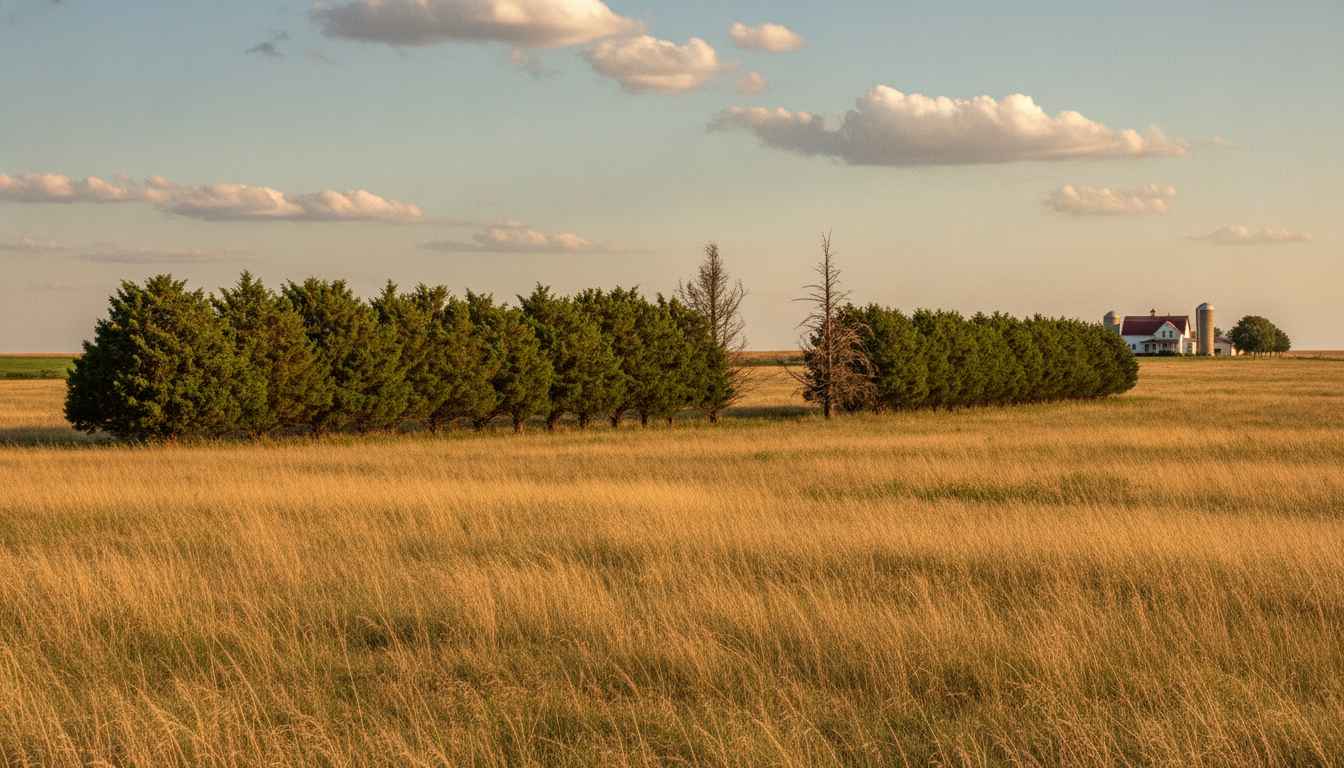
A mostly healthy row of windbreak trees usually needs its failed gap cleared and replanted, not the whole row removed. Windbreaks for Kansas warns, “Any gaps will funnel the wind, eliminating much of the windbreak’s effectiveness.” Judge the gap, crowding, and surviving rows before choosing a larger job.
What should you do with aging windbreak trees?
Start with the condition of the whole row, not one dead cedar. A failed section can often be cleared and replanted independently. That preserves working trees while the replacement section becomes established.
An older, crowded row may need selective thinning instead. Several declining sections can justify phased renewal. Complete removal belongs at the far end of the decision tree.
A tree health assessment can separate crowding from broader decline. The assessment should cover each row, existing gaps, lower-branch density, and failed sections.
Use this framework before removing established trees:
| What you see in the row | Possible scope to discuss | What the written quote should identify |
|---|---|---|
| One failed gap inside an otherwise healthy shelterbelt | Clear and replant only the failed section | Trees removed, stump work, debris handling, site preparation, and replanting responsibility |
| Crowding with enough healthy trees to preserve the barrier | Selective thinning after assessment | Trees selected for removal, access, protection of retained trees, hauling, and cleanup |
| Several declining sections, with useful trees still standing | Phased renewal beginning with the assessed priority area | Work included in each phase, planting responsibility, schedule, and separate follow-up costs |
| A dense row that cannot reasonably be renewed in sections | Full clear-and-haul after evaluating the loss of protection | Row limits, retained trees, stump treatment, hauling, cleanup, and restoration exclusions |
These are different scopes, not interchangeable packages. Compare estimates only when they cover the same trees, access conditions, debris handling, stump work, and replanting responsibilities.
Stumps are also a separate planning decision. Confirm whether each estimate includes stump work and what area must remain undisturbed for replanting. Our stump grinding cost guide explains the variables to discuss.
Why does one gap change the entire shelterbelt?
A windbreak works by slowing wind across a continuous barrier. A hole concentrates airflow instead of simply weakening one small area.
K-State’s guidance says protection can extend across the leeward, or protected, side for 30 times the tallest tree’s height. The degree of protection decreases with distance. The most effective area reaches about 10 times the trees’ height.
That protected zone can cover a home, outbuilding, livestock area, or field edge. For farmstead protection, fuel savings from a windbreak can range from 15 to 25 percent.
Kansas has a large amount invested in these working rows. As of 2021, Kansas windbreaks covered 261,536 acres and stretched 31,348 miles. The Kansas Forest Service estimates they provide at least $100 million in annual value.
The same agency says many Kansas windbreaks are declining or in poor condition. That makes gap repair practical infrastructure work, not cosmetic landscaping.
Nebraska Forest Service guidance, published through UNL CropWatch, separates repairs by age. Small trees can fill gaps in windbreaks less than 10 years old. Gaps in older rows may require larger stock planted with a tree spade.
Weed control and mulching help those replacements establish. Livestock should also be kept away from new plantings. K-State notes that livestock compact soil, break or eat young trees, and damage bark and lower limbs.
When does thinning make more sense than removal?
Crowding is a leading problem inside older windbreaks. Closely planted trees compete for sunlight, moisture, and nutrients. K-State connects that competition with reduced vigor and greater insect and disease susceptibility.
That pattern often appears in aging evergreen rows. Our guide to blue spruce decline in Topeka covers needlecast inside crowded windbreak plantings.
Thinning and pruning aren’t the same treatment. Thinning removes selected trees to improve the row’s spacing. Heavy branch pruning can reduce the density that controls wind and snow.
K-State recommends avoiding windbreak pruning except for dead, diseased, or broken branches. Additional pruning lowers the row’s ability to control wind. As rows age, they may need thinning, replanting, or both.
A few failed trees don’t justify clearing every healthy tree. Selective tree removal can reopen space while retaining most of the barrier.
Complete removal carries a different consequence. Nebraska Forest Service guidance says it can cause the loss of a barrier for 10 to 15 years. That timeframe applies to full removal, not routine gap replanting.
The same guidance recommends consulting a forester before removing an entire row. Removing one row or thinning individual trees may preserve more protection.
Where clearing is necessary, plan around the trees that should remain. Our land-clearing cost guide explains selective clearing around established windbreaks. The Auburn tree service page also covers phased windbreak renewal on area acreage.
Which trees and spacing fit a Kansas windbreak?
A farmstead winter windbreak should have at least two evergreen rows. K-State prefers three rows because one or two rows are less dependable. A few dead trees can create wind-funneling gaps.
That guidance applies to home and farmstead winter protection. Modern field windbreaks commonly use only one or two rows.
Eastern redcedar remains the “backbone” of many Kansas winter windbreak designs. K-State describes it as dense, hardy, and drought resistant. It also holds its lower branches longer than pines.
Our guide to eastern redcedar trimming explains how these trees respond to cutting. Avoid turning a dense lower screen into a high, open row.
Species diversity belongs between rows. Using different species can improve resistance to insects and diseases. It can also support more wildlife habitat.
Within a single row, use one variety when practical. Different growth patterns can cause faster plants to suppress slower ones. Comparable shrubs may be mixed where wildlife habitat is the goal.
K-State’s in-row spacing guidance provides these planning ranges:
| Plant type | In-row spacing |
|---|---|
| Shrubs | 3 to 6 feet |
| Eastern redcedar | 6 to 10 feet |
| Rocky Mountain juniper | 6 to 10 feet |
| Pine species | 8 to 16 feet |
| Short deciduous trees | 6 to 12 feet |
| Tall deciduous trees | 8 to 18 feet |
Use closer spacing in the windward row and in two-row windbreaks. Existing tree condition still matters more than forcing an old row into new spacing.
Some acreage also contains hedge rows beside the shelterbelt. Those require different cutting and pricing. Our hedge-row trimming guide covers that work separately.
How should you plan replanting around the Kansas seedling schedule?
The Kansas conservation seedling schedule makes timing unusually important this year. Landowners relying on that program can’t treat fall 2026 as a normal ordering season.
According to the Kansas Forest Service conservation tree schedule, spring 2026 sales closed April 30. There will be no fall 2026 conservation tree sale because of facility construction.
The program’s posted schedule says spring 2027 sales will resume with bareroot stock only. Containerized conifers won’t be available that season.
For fall 2027, the program expects containerized deciduous trees and shrubs. It doesn’t expect to offer conifer species during that sale.
That leaves no containerized evergreens from the state program on the posted schedule through 2027, and no conifers at all in the fall 2027 sale. An evergreen row may need bareroot stock in spring 2027, another source, or a later planting plan.
Fall 2026 can still support useful preparation. Failed stems can be identified and cleared. Planting locations can be marked, weeds controlled, and livestock fencing planned.
Removed wood and brush require their own disposal plan. Our tree debris disposal guide covers that step, including Kansas burning rules.
What help can rural landowners use before hiring a crew?
Kansas Forest Service district foresters provide guidance for qualifying rural properties. Their services include windbreak management, health, tree planting recommendations, and site visits.
There are seven district foresters covering districts of 10 to 23 counties. The agency says a property visit sometimes takes several weeks. Contact the district forester early if the planting season matters.
This program isn’t a substitute for diagnosing one sick yard tree. The agency’s own list says it can’t provide site visits for non-forest or agroforest land generally under 10 acres. Individual sick-tree questions are routed to K-State Extension.
The Kansas Forest Service also lists “Windbreak Establishment & Renovation” as a funded Landowner Assistance Grant category. That funding window expires in late 2029 and may be obligated earlier.
Applications begin through the Rural District Forester. The listed category doesn’t guarantee an award, so build the project plan independently.
Landowners can handle some work without a commercial crew. Small volunteer seedlings outside the planned row may be pulled or lopped. Weed control, mulching, layout, and livestock fencing can also remain owner-managed.
Established trees, heavy stems, and tangled clearing require a separate scope and safety assessment. Topeka Tree Pro connects landowners with independent insured tree-service providers for thinning, removal, hauling, and lot clearing. Confirm qualifications, access, retained-tree protection, debris handling, and the written scope directly with the provider.
Frequently asked questions
Can I replace one gap without removing the whole windbreak?
Yes, a declined section can usually be cleared and replanted when the remaining row is healthy. Younger windbreaks can accept small replacement trees. Older rows may need larger tree-spade stock to compete within the existing planting.
How far do windbreak trees reduce wind?
Wind reduction can extend along the leeward side for 30 times the tallest tree’s height. The degree of protection declines with distance. The most effective area extends about 10 times the tree height.
What are the best windbreak trees for Kansas?
There isn’t one best species for every row. Eastern redcedar is K-State’s “backbone” for winter windbreaks, while pines, shrubs, and deciduous trees can support a layered design. Use diversity between rows and consistent varieties within each row.
Should old windbreak trees be heavily pruned?
No, windbreak pruning should generally be limited to dead, diseased, or broken branches. Extra pruning reduces density and weakens wind control. Crowded rows may need selective thinning instead.
What does windbreak renewal cost near Topeka?
Windbreak renewal cost depends on the assessed row, access, number and condition of trees, retained-tree protection, stump work, hauling, site preparation, and replanting responsibility. Compare written estimates covering the same phase and exclusions.
Are Kansas conservation seedlings available in fall 2026?
No, the Kansas Forest Service has no fall 2026 conservation tree sale. Its posted schedule also lists no containerized conifers in spring 2027 and no conifer species in fall 2027.
Assess the full row before committing to complete removal. Preserve suitable sections, address assessed gaps, and plan planting around the state schedule. For thinning, removal, or hauling beyond DIY scale, call (785) 333-4052 to request an estimate and connect with an independent insured tree-service provider. Verify availability, qualifications, insurance, written scope, and any estimate or visit fees directly.