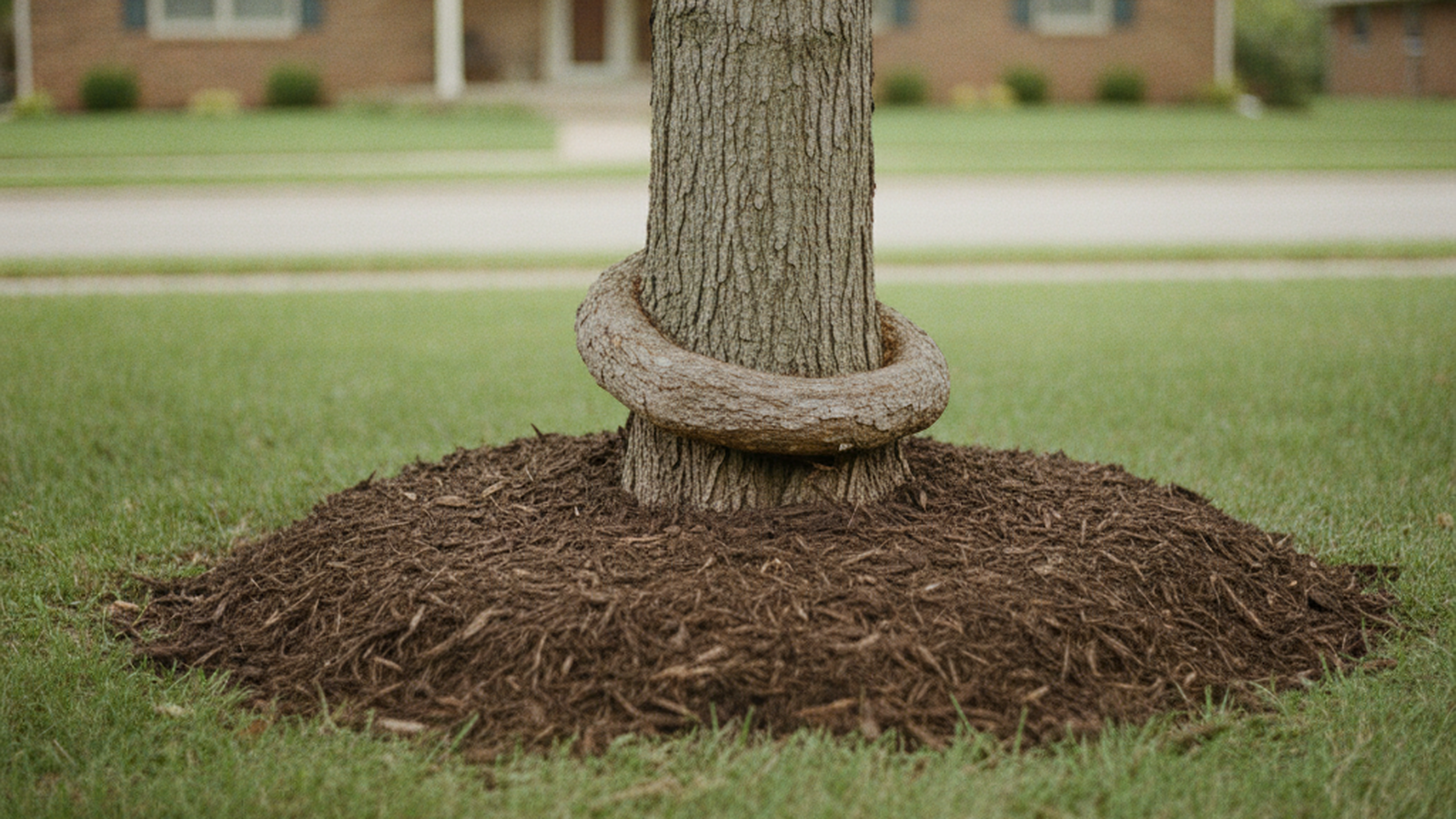
Look at where your tree meets the ground. If the trunk drops straight into the soil without widening at the base, something is wrong down there, and it has probably been wrong for years. K-State Research and Extension’s Kansas guide puts the mechanism in one sentence: roots “tightly wrapped around the main trunk or other roots cause constriction, reducing the flow of water and nutrients in the xylem and phloem.”
The tree does not fall over from this. It thins out, one side at a time, over a decade.
Catching it early is the only version of this with a good ending. Call (785) 333-4052 to be matched with an independent insured provider who can get down at the root collar and look.
What is a girdling root?
It’s one of the tree’s own roots, grown in a circle instead of out away from the trunk, now squeezing the stem it’s attached to. Both the root and the trunk keep adding wood every year, so the gap between them closes on its own schedule. Nothing has to go wrong for the damage to get worse. Time does it.
The Kansas source for all of this is publication MF3132, “Tree and Shrub Problems in Kansas: Diseases, Insects and Mites, and Environmental Stresses,” from K-State Research and Extension. It treats girdling roots under environmental and cultural problems, not disease, which is the right filing: nothing infected this tree.
Its description of how the decline shows up is the useful part. “Large branches on the same side as the girdled roots lose vigor and may eventually die. If a large lateral root girdles a significant portion of the trunk, the plant will become progressively more stressed over a number of years. The main leader may die back.”
Read the first sentence again. Same side. That lopsided thinning is the tell that separates this from drought, from chlorosis, from a borer. A root choking the south face of a trunk starves the branches fed off the south face, and the north half of the canopy stays fine for years while the owner wonders why half the tree looks tired.
How do I know if my tree has one?
Sometimes you can just see it. MF3132 says “Girdling roots are sometimes visible at the base of the tree.”
The hidden ones are the problem, and the guide gives two signs that work from standing height:
- A missing root flare is the first. A healthy tree is “wider or flared at the base as it goes into the soil.” A trunk that enters the ground at the same width it had at knee height is telling you that either a root or a pile of fill is sitting over the flare.
- A flat or dished face on the trunk is the second. MF3132: “if root flares are lacking or the trunk is flattened or concave on one side, an underground girdling root may be present.”
That second one takes a walk around the tree. A trunk should be round. Stand back and look at the lower three feet from two or three angles, and a flat side reads clearly once you’re looking for it.
What you should not do is start digging to find out. The root collar sits in the exact band of soil where the structural roots are, and a shovel swung at a buttress root does permanent damage in a second. This is the part that belongs to somebody with a hand tool and an air spade, which is what an arborist consultation is for.
Be careful about reading a lean as proof. A tree can lean for a dozen reasons, and a leaning tree after a storm in Topeka is usually a root plate problem, not this one.
Why are Topeka trees prone to this?
Three reasons stack up here, and two of them are specific to this ground.
The soil goes heavier as you dig. Pulling USDA soil survey data for Shawnee County, survey area KS177, the picture is consistent: across the major soil components mapped in the county, the surface horizon averages about 25 percent clay, and horizons starting a foot or two down average about 32 percent. Roughly 29 percent of the mapped major-component acreage sits in soils classed as smectitic, which is the shrink-swell clay mineralogy, the kind that cracks open in an August drought and swells shut after a wet spring.
That matters for a planting hole. Dig a round hole in clay with a shovel and the sidewalls glaze over into something close to a pot. The Kansas Forest Service says so directly in its planting guide, which instructs you to “Scarify sides with shovel if glazed” and to make the hole “2 to 3 times wider than root ball” with tapered sides. A root that hits a glazed wall turns and follows it, which is the same circling habit a nursery container produces, just in your front yard.
The tree arrived in a pot. The Kansas Forest Service’s guide, written by Tim McDonnell out of the state office in Manhattan, is blunt about where this starts: “Avoid ‘root-bound’ trees. Roots that circle around the edge of the container may become girdling roots.” Its test at the nursery is a go or no-go, not a judgment call. Remove the container, and “if any spiraling roots are pencil sized, woody, and brown, select another plant.” Smaller, fibrous, light-colored roots can be saved: “Slice deeply into the root ball from top to bottom in several locations to sever circling roots on the surface and in the interior.”
Matt McKernan, a K-State horticulture expert, made the same point in the extension service’s March 2026 planting rules, with the stakes attached. On getting the flare visible at the finished grade: “This is the most important of all the rules. You only get one opportunity to plant a tree at the correct depth.”
The tree is on a street. MF3132 adds a line that lands hard in central Topeka: “Trees planted along city streets are particularly prone to the development of girdling roots.” The parking strips in Potwin, Oakland and Highland Park are narrow, bounded by curb on one side and sidewalk on the other, and a root that can’t go sideways goes around. The same compressed root zone is why tree roots lifting a sidewalk in Topeka is such a common complaint on those blocks.
In the newer stock out the Wanamaker corridor, in Westboro and in Silver Lake, the cause is usually plainer. These are planted trees, twenty or thirty years old, that went in from containers at the wrong depth, and they’re hitting the age where a root that started as a pencil-sized spiral is now wrist-thick.
Is the mulch pile part of this?
Yes, and it’s the one thing on this list a homeowner can fix this weekend.
Markis Hill, the horticulture ornamentals and turf agent for K-State Research and Extension in Johnson County, traced the chain in a 2024 article on mulch volcanos. Deep mulch against the bark compacts and turns hydrophobic as it breaks down, “This can lead the tree to grow additional roots into the mulch for water and air.” Then: “Roots searching for resources could lead to another issue as well. Stem girdling roots. When roots grow close to the trunk and proceed to wrap around the trunk, they increase in diameter along with the trunk.”
So the mound doesn’t just hide the flare. It grows the roots that strangle the tree, in the exact place you can’t see them.
The correct shape, from the same article, is “2-4 inches of even level mulch spread 3-5 ft atop the surface roots,” and the finished result “should resemble a flat doughnut.” The Kansas Forest Service guide says the same in fewer words: “Apply mulch 2 to 4 inches deep with no mulch against the tree trunk.” MF3132 agrees that mulch helps hold even soil moisture, “but mulch should not be piled deeply or directly against the trunk.”
Pulling mulch back off the bark takes ten minutes and a rake, and it’s the rare tree-care job with no downside.
While you’re down there, check what else is wrapped around the trunk. MF3132 lists a whole second category of this damage caused by “wires (for example, from wire baskets around the root ball), rope, string, vines, and other materials that are wrapped around trunks, roots, or branches.” Nursery tags and staking straps that nobody cut off are the usual suspects in a yard, and they girdle on exactly the same timetable.
Can a girdling root be removed?
On a young tree, usually. On an old one, usually not, and that distinction is the whole decision.
MF3132 is measured about it: “In some cases, a tree-care professional can alleviate the problem by removing a section of the root. Regular watering and fertilizing may be needed to improve plant vigor.” Note the hedge in “in some cases,” and note that the recovery plan is aftercare, not just a cut.
Hill’s article draws the line harder: “Stem girdling roots can be corrected on a young tree. Big mature trees, on the other hand, cannot be corrected.”
The reason is structural. On a fifteen-year-old maple, the offending root is a limb-sized part of the tree’s anchorage and its water supply. Cutting it removes a working root and leaves a large wound in the root collar, in wet soil, next to the trunk. On a four-year-old tree the same root is a finger. The cost of removing it scales with the age of the mistake, which is why the window closes.
| Young tree, root still small | Mature tree, root wrist-thick or larger | |
|---|---|---|
| What the work is | Expose the root collar, cut the circling root, restore grade | Exposure and assessment first, and often no cut at all |
| What it costs the tree | A small wound away from a major buttress | A large wound at the stem, and the loss of a structural root |
| Likely outcome | The flare resumes normal growth | Decline that’s already underway continues |
| The honest framing | Worth doing | Worth measuring before deciding anything |
What happens if I just leave it?
It keeps going, and the ending depends on what else the tree is carrying.
MF3132 puts girdling roots on its list of contributors to leaf scorch, alongside “drought, environmental scorch results from other factors, such as a poor root system, root or trunk injuries, girdling roots, or damaging chemicals in the soil.” A strangled tree is a thirsty tree with full access to water it can’t move, which is why these trees look worst in a dry August. If your tree browned out this summer, drought-stressed trees in Topeka covers the version where water really is the problem, and the two look almost identical from the driveway.
The decline list for a buried flare runs long, and MF3132 gives it for soil fill, which produces the same hidden collar: “leaf yellowing, production of abnormally small leaves, premature fall coloration, poor leaf emergence, a thin crown, cankers, or epicormic branching or suckers along the trunk or main branches.” It then names what comes next: “In later stages, wood decay and the associated decay fungi may develop.”
That’s the sentence that turns a health problem into a structure problem. Once decay is in the root collar, the conversation changes from whether the tree looks good to whether it stands up in an ice storm, and fungus on a tree trunk in Topeka covers what a conk at the base is telling you by then.
Sprouts low on the trunk are worth taking seriously for the same reason. A tree pushing epicormic shoots out of its lower stem is running an emergency program, and on a maple it often arrives in the same decade as the rest of the decline described in silver maple lifespan in Topeka.
Frequently asked questions
Can a tree recover from girdling roots?
A young one can, if the root is cut before it’s structural. MF3132 says a tree-care professional can alleviate the problem in some cases by removing a section of the root, with watering and fertilizing to help the tree regain vigor. On a mature tree, the Johnson County K-State position is that it cannot be corrected, and the realistic goal shifts to managing the decline and watching the structure.
What causes girdling roots?
MF3132 names the two primary causes as “improper planting and poor production practices,” with container-grown stock singled out: young trees that spend too long in a pot develop root systems that spiral along the container walls, and if those roots aren’t trimmed or straightened at planting, girdling follows. Deep mulch piled against the bark is the third common cause, because it invites new roots to grow into the mound right against the trunk.
Will a girdling root make my tree fall?
Not directly, but it raises the odds over time. The root constricts water and nutrient flow, the canopy thins on the affected side, and the guide notes that decay and decay fungi can develop in later stages at the collar. Decay at the base is a structural issue, and whether a given tree is a risk to a house, a car or a sidewalk is an on-site judgment about that tree and what it would reach. Tree risk assessment in Topeka walks through how that call gets made.
Should I dig around my tree to look for girdling roots?
No. The root collar is where the structural roots are, and a shovel cuts them before you see them. Looking from above ground is free and safe: check whether the trunk flares at the soil line, walk around it looking for a flat or concave face, and pull back any mulch that’s touching bark. Anything below the surface needs hand excavation or air tools, which is part of a tree health assessment.
How do I keep this from happening to the next tree?
Buy and plant correctly, because the fix is almost entirely at planting. The Kansas Forest Service guide says to pull a container tree out of the pot before you buy it and reject it if the spiraling roots are pencil sized, woody and brown, to slice the root ball top to bottom to cut circling roots, to set the flare at soil level, and to keep mulch off the trunk. It also notes you may plant higher in heavy soils, which is worth remembering given how much clay sits under this county. When to plant trees in Topeka covers the timing side.
When to call us
A missing root flare on a mature tree is not an emergency, but it is a clock, and the trees that get looked at in year five are the ones that get saved. Get a provider out while the question is still whether a root can be cut, not whether a trunk is sound. If the tree is already thinning on one side, dropping limbs, or showing fungus at the base, the question has moved to tree removal territory and it should be measured by somebody standing at the trunk.
Call us at (785) 333-4052.
Topeka Tree Pro is a referral service serving Shawnee, Jefferson, Jackson, Osage and Wabaunsee counties. It connects property owners with independent insured providers and does not perform the work itself. Confirm a provider’s credentials, current insurance and written scope directly before hiring.