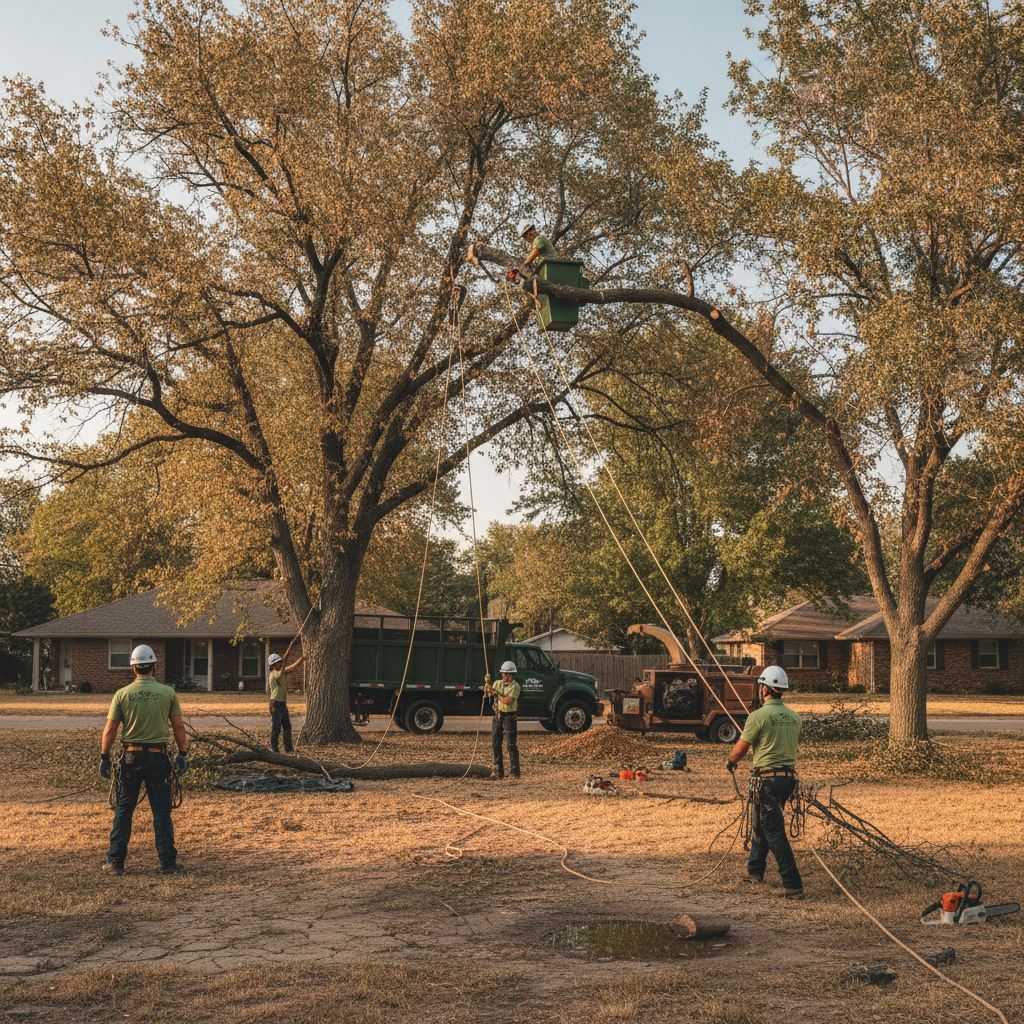
Brown, crispy leaf edges on a Topeka tree are usually drought stress, not a mystery blight. On the heavy clay under Highland Park, Potwin, and a lot of Shawnee County yards, a wet stretch followed by hot, dry weeks cooks the fine roots that sit in the top of the soil. The canopy still looks green from the street, then the margins scorch, leaves drop early, and twigs die from the outside in.
Kansas drought on heavy clay
Greater Topeka sits in a genuine four-season climate with hot, humid summers, a real freeze season, and clay that behaves like a sponge one month and a brick the next. After a soak, that clay holds water. As it dries, it shrinks and opens cracks that shear the hair-like feeder roots a tree uses to drink. The tree did not “catch something” overnight. The ground changed under it.
The same ground can flood first. North Topeka sits on the Kansas River floodplain, and a cottonwood on that bank is built for wet feet. When the river recedes and a dry, windy stretch follows, those roots have already taken an oxygen hit. They cannot keep a full crown supplied. That wet-then-dry cycle is why a river-bank cottonwood at NOTO and a silver maple on a tight Oakland lot can show the same scorched edges in the same month.
Turf irrigation hides the problem on newer lots along the Wanamaker corridor, through Westboro, and out toward Silver Lake and Rossville. A lawn sprinkler wets grass a couple of inches down. A mature tree is drinking farther out, under the drip line, where the soil may still be powder. The yard looks tended. The tree is not.
Ice is the winter half of this story. A drought-stressed union already holds less stored energy and more dead wood. Freezing rain loads that wood until it fails, and a tree that shrugged off snow can drop a big limb in ice. Spring hail and straight-line wind do the same job on brittle twigs. For watches, warnings, and what the air is actually doing, use the National Weather Service Topeka office.
Yellow leaves with green veins are a different pattern. On our clay, pin oak and some maples often show iron chlorosis, a nutrient-uptake issue, not a water shortage. Brown, crispy margins that start at the tip and work inward are the drought pattern. A tree can carry both at once. A species, a photo, or a street name does not settle which one you have. An on-site look is what separates them.
Out in Osage County, around Auburn, Berryton, and Overbrook, the clay still holds, but the setting is acreage, hedge rows, and longer drives with no city forestry to call. Jackson County’s square in Holton has old canopy trees over a county-seat lawn, then farmland around it. Perry Lake shoreline in Jefferson County adds a different moisture story again, because Corps land and reservoir edge are not a city terrace. Same drought. Different ground.
Deep water versus a daily sprinkle
A slow soak at the outer edge of the crown is what a drought-stressed tree can actually use. A daily sprinkle is mostly a lawn habit. Short bursts wet the crust, then evaporate or sheet off sealed clay. Grass greens up. Woody roots stay dry.
Trees move water from roots to leaves against a pull from the canopy. Hot, windy days increase that pull. When the soil cannot replace what the leaves lose, the cells at the leaf margin die first. That is scorch: a brown, brittle rim on an otherwise green leaf. On evergreens the same shortage shows up as needles that yellow, then redden, then brown, often starting at the tips or on the most exposed side.
Newly planted trees show it first because the root system that left the nursery is a tight ball, not the wide net a mature tree has been growing for decades. A young redbud in a Westboro parking strip can be in real trouble after a few hot, dry weeks, while the bur oak two lots over is still holding. Water the new tree at the root ball and a little beyond it, slowly, so the water sinks instead of running down the driveway.
Organic mulch helps for a mechanical reason, not a decorative one. Chips shade the clay, slow evaporation, and keep mower decks off the root flare. Pile them against the trunk and you trap moisture on bark that needs to dry, which is the opposite of help. Leave a gap at the stem and let the mulch sit out under the crown, where the feeder roots actually are.
Do not push new growth while the tree cannot take up water. Fertilizer salts sit in dry soil and can burn the same fine roots you are trying to save. Killing the grass under the drip line reduces competition, but chopping the soil deep to do it cuts those roots. A hose on the ground, left to trickle at several points under the outer canopy, is the useful weekend job. Climbing, a chainsaw above shoulder height, a ladder, or a limb that is hanging or under tension is not.
| Daily lawn sprinkle | Slow soak at the drip line |
|---|---|
| Wets turf roots and the clay crust, then evaporates. | Moves water down into the root zone under the outer crown. |
| Trains shallow roots toward the surface, where clay cooks first. | Reaches the feeder roots that actually supply the canopy. |
| Looks like care because the lawn stays green. | Looks uneventful for an hour, then the soil is actually moist. |
Dead wood that is already brown to the cambium will not green up because you watered. It can come off any time. Routine pruning of live wood on many deciduous trees belongs in late February through April, before bud break, which is the window K-State Research and Extension describes. Heavy live cutting on a drought-stressed tree removes the leaf area the tree uses to refill reserves. If the deadwood is overhead, near a roof, or mixed with live wood you cannot read from the ground, that is tree trimming for an insured provider, not a weekend on a ladder.
Anything touching or even possibly near a power line is not a watering problem. The pole-to-pole span is Evergy’s to review. The line from the pole to the meter is the customer’s responsibility. Call Evergy’s vegetation line at 888-471-5275 before anyone works near that conductor, and do not touch a branch that is on a line.
Which species show it first
River and floodplain trees show drought first because they evolved with water underfoot. Cottonwood, willow, river birch, sycamore, and aspen wilt, scorch, and thin while deeper-rooted upland trees are still holding. A cottonwood on the Kansas River bank is a different plant from a bur oak on a Wabaunsee ridge, even if both live in the same county.
Silver maple is the city version of that story. Older neighborhoods in Potwin, Oakland, Highland Park, and North Topeka are 1880s-to-1950s housing under a mature street-tree canopy, and silver maple was planted there in volume. Its roots run shallow, its unions are often weakly attached, and drought makes an already brittle crown drop wood. On a small lot the drip line sits over a driveway, a sidewalk, and sometimes city right-of-way, so whose tree it is can be a real question before anyone schedules a cut.
Ash is a stacked case. Emerald ash borer has been confirmed in Shawnee County since 2017, Jefferson since 2015, Jackson since 2019, and Osage since 2022, per the Kansas Forest Service county list. A county listing means the insect has been found somewhere in that county. It does not mean a particular ash on a particular lot has it. What it does mean is that an ash already under insect pressure has less reserve left when clay dries out. Do not read a canopy-loss percentage as a treat-or-remove rule from a photo.
Blue spruce and other needled evergreens in foundation beds along newer southwest Topeka streets often brown from drought and from being planted where heat reflects off siding and driveways. Japanese maple, birch, and a newly set crabapple fail in the same heat for the same reason: small roots, high demand, clay that will not pass a sprinkle.
The trees that shrug this off are not a single winner. Native bur oak handles dry clay better than a river birch. Osage orange in those old hedge rows through Osage County was planted as living fence before barbed wire, and it is built for hard ground. Eastern redcedar creeping into a pasture near Alma, Eskridge, or Harveyville is a drought survivor, which is exactly why it takes the grass. Honey locust, already common in town, generally keeps going when a silver maple is already scorching. “Most drought-tolerant” is the wrong question for a lot. Match the species to the site: upland oak and hedge on high clay, not a moisture-loving tree in a parking strip with a turf clock.
A tree can recover from drought stress if the cambium is still alive and the roots can take water again. Recovery is slow. The tree spends the next seasons rebuilding reserves, and the next ice load or hail cell is when a weakened union actually fails. Death often lags the dry weather. That is why a crown that looks thin this September can keep declining after the rain returns. No living tree can be certified safe, and a species or an address does not tell you this one will make it.
When the canopy is mostly dead, bark is shedding, and the stem is a hazard over a roof or a drive, tree removal is the honest next step, done by an independent insured provider, not by the brand on this page. Drought-weakened wood that comes down in ice or wind is storm-damage cleanup, arranged as providers have capacity. Confirm current proof of insurance with the matched provider before work begins. Kansas has no statewide tree-service licence and no statewide general contractor licence. The City of Topeka licenses contractors who work inside city limits. Most of the smaller towns and counties in this footprint license nothing at all. Ask for the name of the person who will inspect the tree, then check that name in the International Society of Arboriculture directory. If the work is inside Topeka, confirm the city licence with the City of Topeka.
Common drought questions
Can a tree recover from drought stress?
Many do, especially established trees whose roots and inner bark are still alive. Scorched leaves are spent tissue. They will not turn green again, but new leaves can, once water is back in the root zone and the tree has time to refill its reserves. Twig dieback is the tree sacrificing outer growth to keep the main stem alive. A tree that goes into the next ice season with a thin crown and dead wood in the unions is still a failure risk even if it “survived” the dry stretch. An on-site assessment looks at live cambium, root collar, unions, and what sits under the crown. It does not certify the tree as safe.
What are the symptoms of drought stress in trees?
Wilting or curling leaves are often the first move, the same way a houseplant droops when the pot is dry. Leaf scorch follows: a brown, crispy margin on a leaf that is still green toward the midrib. Deciduous trees may drop leaves early or color up weeks ahead of a normal Topeka fall. The whole canopy can look thinner, with smaller leaves than last year. Twigs die from the tips inward. On evergreens, needles yellow, then brown, and stay attached or shed depending on how far the shortage has gone. Damage typically shows in the outer, upper crown before the interior. Suckers at the base are a stress response, not a sign the tree has a plan.
How do you save a stressed tree?
Stop the daily sprinkle and put water where the roots are, slowly, under the drip line, so it soaks into clay instead of running off. Mulch the soil surface and keep it off the trunk. Cut competition from turf if you can do it without ripping roots. Leave live wood on the tree until a provider can tell you what is actually dead. Do not climb, do not cut a hanging or taut limb, and do not work near a line. If the tree is newly planted, the root ball is the whole drinking system, so that is the circle that has to stay moist. If the tree is mature and already dropping large wood, watering is still useful, but the structural question is separate and belongs to an inspection on site.
What is the most drought-tolerant tree?
There is not one answer for Greater Topeka, because the ground changes from a Potwin terrace to a Flint Hills windbreak. Bur oak and Osage orange take dry clay better than cottonwood, river birch, or sycamore. Eastern redcedar handles drought on Wabaunsee pasture, which is why it encroaches. Honey locust generally outlasts silver maple in a hot, dry stretch. A blue spruce against a west wall is a poor bet no matter what the tag said. Pick for the site you have, not for a ranking.
When to call us
Call when scorched leaves have turned into dead limbs over a roof, a drive, or a play area, or when you cannot tell live wood from dead from the ground. That is insured tree-service work, not a hose and a weekend. We match Greater Topeka property owners with independent insured providers, from Silver Lake to Overbrook and from Holton to Alma, and the line is answered. Call us at (785) 333-4052.