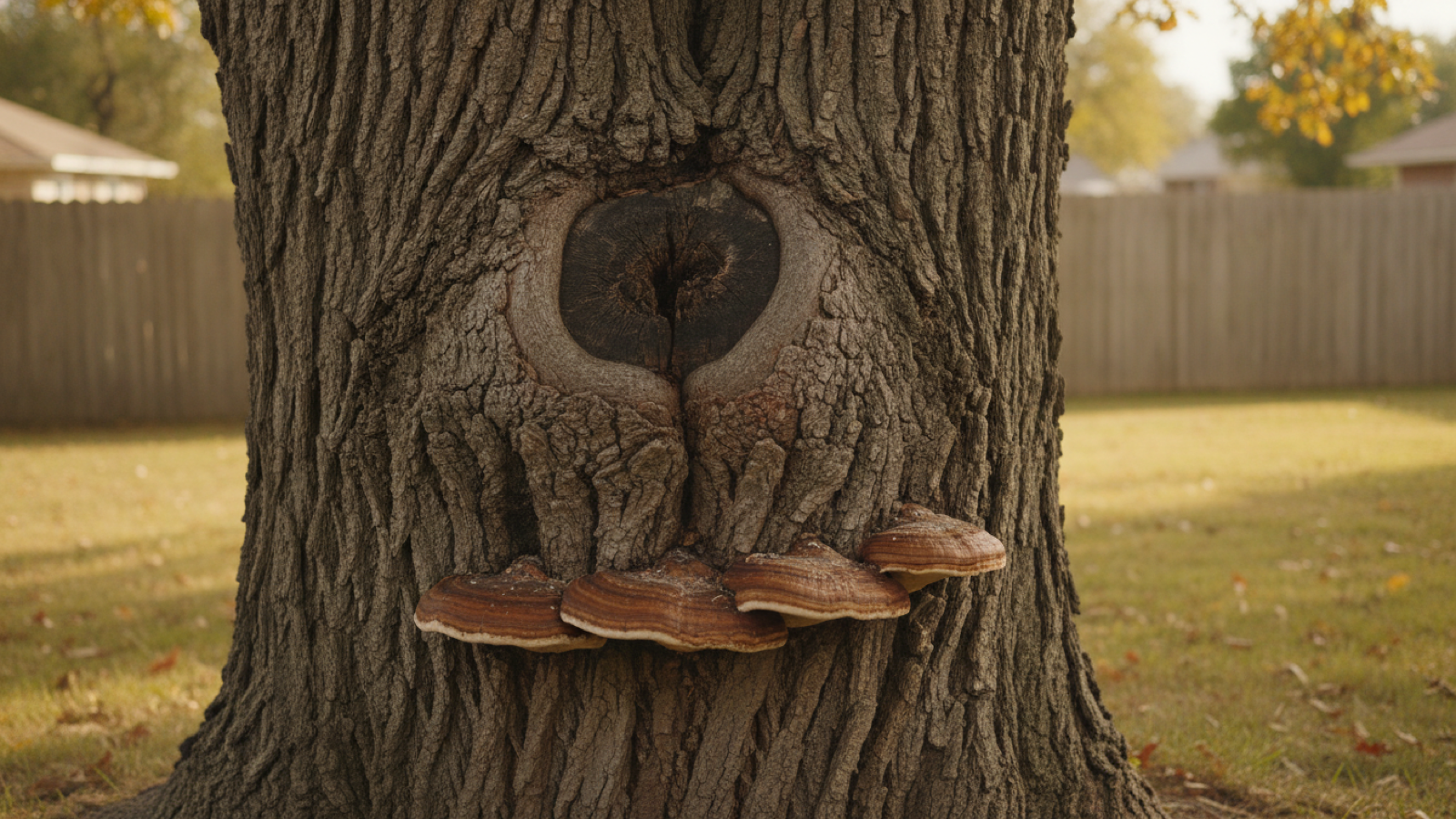
A shelf of fungus growing out of a tree trunk is not something living on the bark. K-State Research and Extension’s Kansas guide calls conks and mushrooms “the reproductive structures (fruiting structures) of wood-rotting fungi,” and says their presence “also can indicate decay.” The fungus is fruiting because it has already been eating wood inside the tree.
That is the part most people get backwards. The conk is not the beginning of a problem. It is the visible stage of one that started at a wound years earlier.
What it means for your particular tree depends on how much wood is gone and what the tree would hit. That is an onsite call, not a photo call. Call (785) 333-4052 to be matched with an independent insured provider who can look at the actual trunk.
What does a conk on a tree actually mean?
The Kansas source here is publication MF3132, “Tree and Shrub Problems in Kansas: Diseases, Insects and Mites, and Environmental Stresses,” published by K-State Research and Extension in November 2023. Its wood decay section is the one worth reading before you read anything written for a different state.
It defines the process plainly. Wood decay “is the progressive deterioration of the cell wall substances (lignin and cellulose) of wood, caused primarily by fungi that produce enzymes capable of degrading those substances.”
Then it states the consequence, and this is the sentence that matters in a Kansas yard: “Wood decay reduces the strength of branches, trunks, and roots, which poses a risk to structures, cars, or people, especially during windy weather or ice storms.” For decay down at the roots it is more specific still. “Trees and shrubs with decayed roots are prone to falling due to loss of root anchoring strength.”
Topeka gets both of the conditions named in that first sentence. Wind and ice are not hypothetical here, and ice storm tree damage is what the loading actually looks like when it arrives.
Can a tree be rotten inside with no fungus showing?
Yes, and MF3132 says so twice.
“Decay is often invisible from the outside except where wounds or injuries have removed the bark.” And directly after the line about conks and mushrooms: “It is common, however, for decay to occur without any fungal growths visible.”
So a clean trunk is not a clearance. The publication lists what else to look for: “soft, spongy, discolored, or crumbling wood” where bark is missing, plus “hollow cavities, cracks, swellings in the trunk or branches, or general decline.”
Swellings are the one people walk past. A bulge is often the tree laying down extra wood around a weak spot, which means the weak spot is real. If the tree is also thinning or dropping branches, how to tell if a tree is dead in Topeka walks through the checks that separate dormant from finished.
Does the kind of tree tell me which fungus it is?
Often, yes. This is the useful part of MF3132 that almost nothing else online gives you, because the host tables name the decay fungi species by species for Kansas trees.
Oak. The table lists Armillaria mellea among others, and describes the tell: “Armillaria produces black fungal shoestring-like growth (rhizomorphs). In the fall yellow to tan (orange) mushrooms are seen at the base of the tree.” It is early October now, so that is the window those mushrooms show up in. The publication’s photo captions also describe “Thick fungal threads (rhizomorphs) of Armillaria root rot” and an “Armillaria mycelial fan.” One management line in the oak row is worth keeping for later: “Do not replant in sites where Armillaria was present.” Separately, the guide’s photo of decay indicators is captioned “Ganoderma root and butt rot of bur oak.” Oak decline here has more than one cause, and oak wilt in Topeka and Kansas covers the one that spreads between trees.
Hackberry. The table names Ganoderma, Phellinus and others, and gives the clearest conk description in the document: “The fungus causes a white, spongy rot of the roots and root collar. In the advanced stages of Ganoderma root rot, the fungus produces amber to reddish-brown, hoof-shaped conks at the base of the tree.” Hoof-shaped and at the base, not up in the canopy. More on the species in hackberry trees in Topeka.
Honeylocust. Also Ganoderma spp., described as producing “reddish-brown conks (fruiting structures) on roots and the lower trunk.” The rest of what goes wrong with this tree is in honey locust tree problems in Topeka.
Maple. The row lists Armillaria mellea and Ganoderma lucidum among others. Decay, not disease, is the usual ending for the fast-grown maples, which is the whole argument in silver maple lifespan in Topeka.
Elm. Pleurotus ostreatus, Phellinus spp. and Ganoderma spp. are named. The comment column here is blunter than most: “Avoid wounding the base of the tree. No control is available once infection has occurred. Trees that are a structural risk should be removed.”
Black locust. Phellinus robiniae and others, with a distinctive description: “The fungus causes a white rot of the heartwood leading to spongy yellow tissue. Large, brown to black bracket-shaped conks form on the bark.” The guide adds two qualifiers that travel with it. The disease “is often associated with locust borer injury,” and it is “Common in old trees.”
Crabapple. Xylaria and others, and it looks like nothing else: “Xylaria fruiting structures are finger-shaped, black, charcoal-like projections, which develop at the base of the tree.” People mistake these for burnt sticks in the mulch.
Ash. The ash row names Perenniporia fraxinophila and others, filed as heart rot. The publication’s own illustration of decay indicators is captioned “ash heart rot caused by Perenniporia fraxinophila.”
None of that is a diagnosis of your tree. Conk identification from the ground is unreliable, and two different fungi on the same species can mean very different amounts of lost strength.
Why does the ash case matter here?
Because Shawnee County already has a reason for ash trees to be dying.
The Kansas Department of Agriculture announced in 2017 that it, “along with the U.S. Department of Agriculture, has confirmed the presence of emerald ash borer (EAB) in Shawnee County, Kansas,” with the USDA lab confirmation dated June 7, 2017. The Kansas Forest Service’s tracking page lists “Shawnee (2017)” among Kansas detections.
A declining ash and a heart rot fungus are two separate problems that arrive at the same tree. The borer kills the canopy. The decay fungus takes the structure. One of those makes a tree look bad, and the other decides whether it stands up in a storm. Emerald ash borer in Shawnee County covers the insect side, and emerald ash borer treatment cost in Topeka covers the treat-or-remove question.
Where did the decay get in?
Through a wound. MF3132 is specific: wood decay organisms “colonize through wounds, branch stubs, and other compromised sites.”
Trees do fight back. The publication says they “have natural defense mechanisms that may ‘wall-off’ (compartmentalize) the decay process to a certain portion of the plant, but this barrier may be breached with additional wounding or injury.” Read that whole sentence. The wall holds until something cuts through it again.
That is why how a tree was pruned matters years later. K-State Research and Extension’s Shawnee County office, in its 2018 handout on pruning storm damaged trees, says topping, “where all the main branches are cut and there are only stubs left, is not a recommended pruning procedure.” Stubs are on MF3132’s own list of entry points. The same handout gives the correct cut: “Prune broken branches back to the next large branch or to the trunk,” and “If cutting back to the trunk, do not make the cut flush with the trunk but rather cut at the collar area.”
Put those two Kansas documents side by side and the reading is ours, not theirs: in Topeka, a storm break that was cleaned up badly and a tree that was topped are both decay invitations with a delay built in. Tree topping in Topeka is the longer version of why that cut keeps costing.
Mower and trimmer damage counts too. The hackberry and elm rows both say to avoid wounding the base of the tree, and the base is exactly where a string trimmer lives.
Is there a treatment for wood decay?
No. MF3132 does not hedge on this: “There are no ‘cures’ for wood decay.”
What it offers instead is prevention. “Wood decay can be prevented by avoiding wounding. Pruning cuts should be made when branches are small to minimize wound size.” It also notes that “Once the decay process has been initiated, it is difficult to control.”
So if a sprayer, an injection or a fungicide gets offered as a decay treatment, that is not what the Kansas publication supports. Nothing you paint on a trunk puts lignin back.
Hollow does not automatically mean condemned, either. A tree can carry a cavity and still have enough sound shell to stand, and it can also look solid and be nearly empty. The only honest answer is that the amount of remaining sound wood has to be measured at the tree.
Does a conk mean the tree has to come down?
That is not a question a web page can answer, and MF3132 routes it the same way we do.
Its instruction is to “Routinely inspect trees and shrubs for indications of decay.” Then: “A trained tree-care professional should evaluate trees with conks, mushrooms, or other symptoms of decay. A certified arborist should remove trees that pose a risk to people, structures, or vehicles.”
Notice the two halves. Evaluation comes first, and removal is tied to risk, not to the presence of a conk. The host tables repeat the same split in their own words: “Trees with indications of decay should be evaluated by a tree-care professional. Trees that are a structural risk should be removed by a certified arborist.”
Risk is about what the tree would reach. The same decayed limb is a different decision over open lawn than over a driveway or a bedroom, which is the point of tree risk assessment in Topeka. A tree health assessment puts somebody at the trunk and the root collar, and an arborist consultation is the version that produces a written report you can hand to an insurer or a neighbor.
Do not assume hardware solves it either. Cabling and bracing addresses certain structural defects, and nobody should promise it makes a decayed trunk safe.
What should you do next?
Stay off it and under nothing. If a limb with fungus on it is cracked or hanging over a structure, treat it as a hazard today, not a project for the weekend. Emergency tree service is the matching page, and fallen limb roof and fence damage in Topeka covers what happens after something lands.
Photograph the conks before anything changes. Where they are on the tree, how many, and whether they are at the base, on the trunk or at an old pruning cut all mean different things to whoever comes out. Fungal structures weather away, and the one you can see this week may be gone next month.
If removal ends up being the answer, carry the Armillaria note forward: the oak row in MF3132 says not to replant in sites where Armillaria was present, so the replanting conversation belongs in the same visit as the stump. Stump grinding cost in Topeka and tree removal cover the scope questions to settle in writing first.
Topeka Tree Pro is a referral service serving Shawnee, Jefferson, Jackson, Osage and Wabaunsee counties. It connects homeowners with independent insured providers and does not perform the work itself. Verify a provider’s credentials, insurance and written scope directly before hiring. Call (785) 333-4052 to get matched.