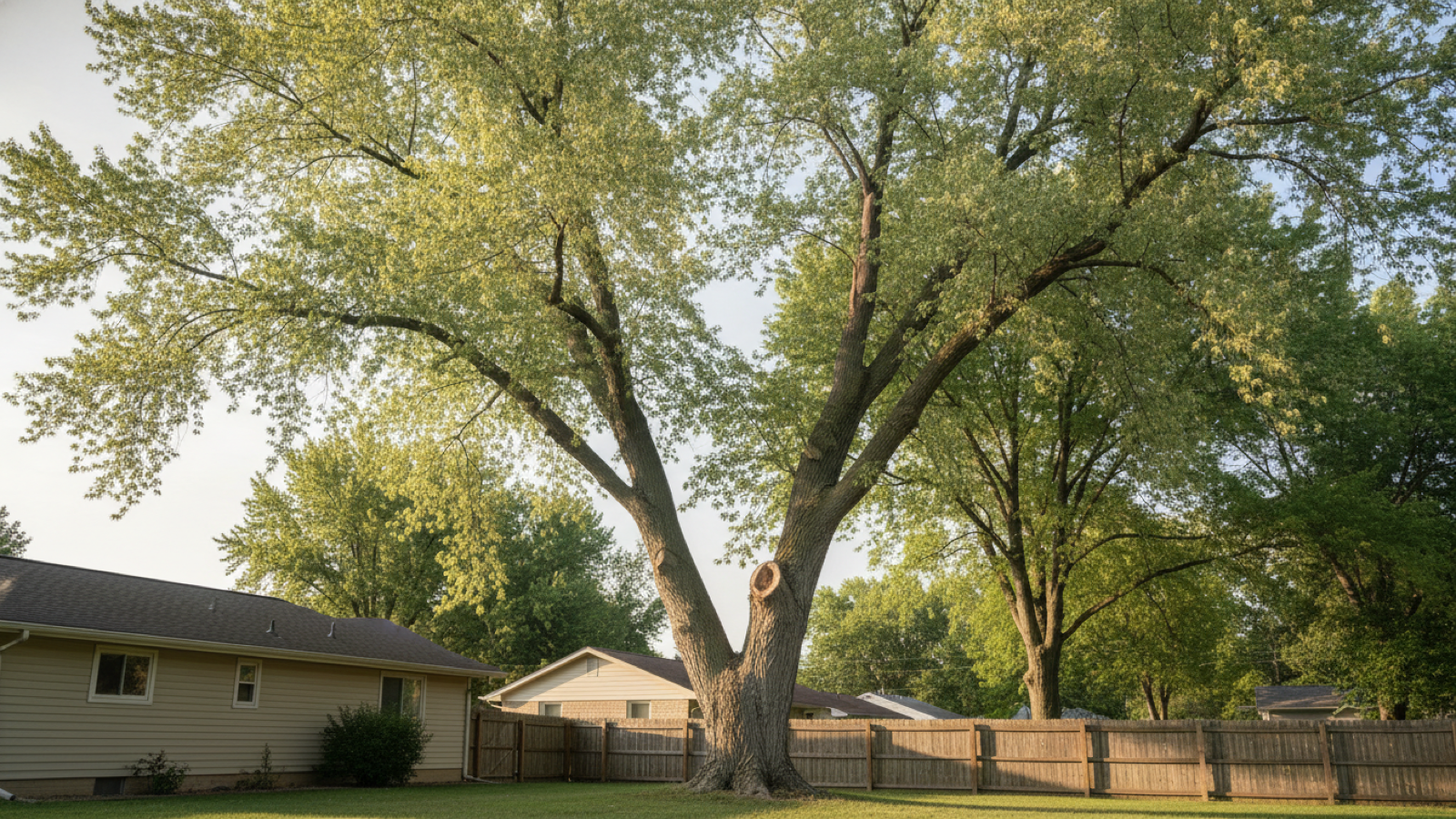
A big silver maple dropped a limb this summer. Or the trunk splits low into two competing stems. Or the leaves went yellow between green veins. The question under all three is the same.
A silver maple may live 130 years or more. In a Topeka yard, structure usually runs out first.
The 130-year figure is a species maximum. It comes from the USDA Forest Service’s Silvics of North America. It describes trees in native floodplain habitat. It isn’t a Topeka yard expectancy.
Kansas sources describe a different clock. A K-State Research and Extension Johnson County agent article, written for the Kansas City metro, walks the mature-tree sequence: limbs break in storms, then decay develops. K-State’s Kansas problem table rates every maple foliage disease as cosmetic. The wood-decay row is the one that sends you to a professional.
Our reading of that gap is simple. The structural clock runs shorter than the biological one. That isn’t a Forest Service sentence. It isn’t a K-State sentence. It’s the two clocks set next to each other.
How long does a silver maple actually live?
The Forest Service silvics account is the species biology source. It says: “Growth is rapid in both pure and mixed stands and the tree may live 130 years or more.”
Keep the “may.” That is a floodplain maximum, not a yard promise.
The same account lists other names: “it is also called soft maple, river maple, silverleaf maple, swamp maple, water maple, and white maple.” Those names describe the native site. A river bottom is not a Topeka lawn. Topeka sits on the Kansas River. A back yard on shrink-swell clay, with a hot dry late summer, is still not floodplain forest.
Mature size in that account, in the inch figures: 90 to 120 feet tall, with trunks 36 to 48 inches. A large yard tree can still sit well short of that.
Silver maple is “the first of the maples to bloom in North America, beginning as early as February and extending into May.” That is a continental statement. It isn’t a Topeka bloom calendar.
The Forest Service also notes: “Silver maple is cut and sold with red maple (A. rubrum) as soft maple lumber.” Soft maple there is a lumber grade name. It isn’t a strength test. Don’t read a number into it.
Why is the yard clock shorter than the biology clock?
A K-State Research and Extension Johnson County agent article puts silver maple on a personal do-not-plant list. The article is unsigned and first-person. It is written for the Kansas City metro. It isn’t a peer-reviewed K-State publication. It isn’t a statewide recommendation. Shawnee County is next door, not the same office.
The agent writes: “On my do not plant list are several species of maples. I will start with the least controversial, silver maple.”
Then the failure sequence: “This long available tree is a nice specimen, but due to the fact that it is soft-wooded it does not show its true colors until it is mature. At that point limbs will break in storms and then decay develops which leads to defects and a costly unwanted removal.”
On fast growers generally, the same article says: “As a rule, fast growing trees are weak wooded, tend to break under wind and ice, easily develop defects including rot and decay, and, in the scheme of life, tend to live for a shorter period of time.”
On what makes a good shade tree, the agent says it “should resist breaking up in an ice or wind storm.”
That is one office’s recommendation for the Kansas City metro. We aren’t going to flatten it into “K-State says.” We also aren’t going to hide a later disagreement with the Kansas Forest Service list. Both Kansas sources get to speak.
Ice and wind are the loading events in that sequence. We don’t have a sourced Topeka storm date, loss count, or ice-loading figure to put on this page. The local mechanics of a loading event are in ice storm tree damage in Topeka.
What does not end a silver maple in Kansas?
This is the useful surprise.
K-State Research and Extension MF3132, Tree and Shrub Problems in Kansas, has a maple host table. Every foliage disease in that table gets the same verdict: “Rarely damaging, primarily cosmetic, no management needed.” That covers anthracnose, leaf blister, leaf spot, tar spot, and purple eyespot.
Bacterial wetwood is close, with different wording: “Rarely damaging, primarily cosmetic, management not necessary.” Quote the row you mean. Don’t swap the two lines.
The Forest Service silvics account says: “There are no serious insect pests of silver maple, but the species is attacked by borers, leaf feeders, and scale insects.” Both halves stay in the same breath. “No serious insect pests” alone would read as no insects. The source contradicts that in its own next clause.
MF3132’s maple table lists exactly one insect row: woolly alder aphid (Prociphilus tessellatus). That is what the Kansas table contains. It isn’t a claim that Kansas maples have no insect problems.
If the leaves look ragged after a wet spring, that usually isn’t the lifespan story. Our reading of the two tables is that decay is the failure mode, not disease. That is our reading, not either publication’s headline. For the dead-or-dormant test, use how to tell if a tree is dead in Topeka. Yellowing with green veins is a different branch. That’s next.
What actually ends a silver maple?
Decay you may not see until the structure is already compromised.
MF3132’s wood decay and root rot row names Armillaria mellea, Ganoderma lucidum, and others. The comments say: “Symptoms of decay may not be visible until extensive structural damage to the tree has resulted.” Then: “There is no control once the fungus has colonized the wood. Trees with indications of decay should be evaluated by a tree-care professional. Trees that are a structural risk should be removed by a certified arborist.”
That last pair is K-State’s own referral. We aren’t going to rule on a tree we cannot see. We aren’t going to issue a species-level removal verdict from this page.
The Forest Service silvics account is more specific on shoestring root rot: “Shoestring root rot (Armillaria mellea) is common on the species and kills trees that are already in a weakened state.” It does not say Armillaria kills a healthy silver maple. The weakened-state limiter is part of the fact.
A low, competing fork is a separate structural problem. The Kansas Forest Service preferred-tree chart for northeast Kansas says, about form in general: “Multi-stemmed forms are more likely to be damaged from snow, ice, or wind.” That is a form statement. It isn’t a Kansas Forest Service statement about silver maple.
A divided trunk is a loading question. Ice and wind do the work. Whether hardware is even on the table is an onsite call. We walk that decision, without a safety promise, in cabling versus removal. A tree risk assessment is how a matched provider puts a rating on unions, decay, and targets they can actually see. Nobody can finish that from a photograph. Cabling or bracing is not a promise the tree is safe.
What if the leaves are yellow with green veins?
That is often iron chlorosis, not old age.
Kansas Forest Service and K-State publication MF718, Iron Chlorosis in Trees, puts silver maple in the most susceptible tier. The four species in that tier are pin oak, silver maple, baldcypress, and sweetgum. Keep that tier distinct from the longer “may develop” list.
The Kansas soil premise in MF718: “In most Kansas soils, iron is plentiful, but unavailable to trees.” The iron is present and locked up. Kansas soils don’t lack iron.
Availability tracks pH. “Iron is readily available to trees growing in soils with a pH of 5.0 to 6.5. In soils with a pH of 7.0 (neutral) and above, iron changes to an insoluble form that is not as available to trees.” Both halves travel. 7.0 is the threshold, not a Topeka soil reading. Nobody sourced a pH number for a Topeka neighborhood.
On deciduous trees, “iron chlorosis causes the leaf veins to remain green while the area between the veins is yellow-green to yellow.” That is the sign. It is scoped to deciduous trees.
Progression in severe cases can run yellow to white to brown. Twig dieback may follow. “After several years, the tree may die if the condition is not treated.” That isn’t a one-season death sentence. Don’t compress it into “chlorosis kills trees.”
A K-State Johnson County article on yellowing tree leaves says: “It will take a lifetime of treatments as there is no one-time fix to the high pH soils that create the problem.” Quote the full sentence. The fragment isn’t the claim.
MF3132’s maple table carries the same vein-green yellowing sign. Comments: “Avoid planting susceptible species in high pH soils. In severe cases provide iron with injections.”
MF718’s seasonal limit matters if you’re reading this after midsummer. “A response is normally seen within two to three weeks if applied in the spring after leaves are fully developed. Trees treated later in the summer may not show a response until the following year.” Both halves stay. An injection ordered now may not green up until next spring.
If you want a soil test, take it to the office that will actually receive it. K-State Research and Extension, Shawnee County, is at 1740 SW Western Avenue, Topeka, Kansas 66604. Phone 785-232-0062. Open Monday through Friday, 8:00 a.m. to 5:00 p.m. That office wants tree and shrub samples at 10 to 12 inches. MF718, a 2003 statewide publication, says samples “about 6 to 8 inches below the surface of the ground.” Those two depths differ, and the difference is real. Follow the Shawnee County depth. That is the lab a Topeka sample goes to. Neither figure is being called wrong.
Diagnosis and treatment options are in iron chlorosis in Topeka trees. Chlorosis is a soil-availability problem. It isn’t proof the tree’s lifespan is over.
What about the roots and the stump?
The Forest Service silvics account: “The species has a shallow, fibrous root system.”
On pipes: “Its prolific root system is notorious for invading and clogging underground drainage and water lines that are not tightly constructed.” Roots exploit an existing defect. They don’t breach sound pipe. Drop that limiter and the sentence is false.
If hardscape is moving, start with tree roots and foundations. That page explains the clay-and-root mechanism. It doesn’t assign a soil series to your street.
Stumps are a second bill. “Prolific sprouting from the root collars and lower stems of living trees is characteristic of the species. Sprouts appear readily from stumps that are 30 cm (12 in) or less in diameter.”
The 12-inch figure is for stumps. Sprouts appear readily at or below that size. The source says nothing about larger stumps either way. Don’t infer that a bigger stump will stay quiet.
Cutting a small silver maple and leaving the collar is often a sprouting problem, not a finished removal. Stump grinding is the decision that actually ends that collar.
What do the Kansas planting lists say?
Two Kansas sources disagree. Both get quoted. We aren’t going to pick a winner.
The same Johnson County agent article that flags silver maple also puts red maple and Freeman maple on that do-not-plant list. Again: “On my do not plant list are several species of maples. I will start with the least controversial, silver maple.” Red maple and Freeman maple sit on that list with it. That is one named office’s first-person opinion piece for the Kansas City metro.
The Kansas Forest Service chart Preferred Trees for Northeast Kansas lists ten maples: Japanese, Amur, Trident, Hedge, Paperbark, Shantung (Purpleblow), Freeman, Norway, Red, and Sugar. Red maple and Freeman maple are on that preferred chart. Silver maple is not.
The chart describes itself: “Not all recommended trees for planting in Northeast Kansas are included. The preferred trees listed were recommended by industry professionals such as city foresters, local tree boards, county and horticulture extension agents, commercial arborists, and retail/production nursery interests.”
Silver maple’s absence is an omission from a non-exhaustive list. It isn’t a ban. It isn’t a prohibition. It isn’t a Kansas Forest Service statement about silver maple. The chart makes no statement about the species. We aren’t going to write one onto it.
The Johnson County article is one office’s first-person recommendation for the Kansas City metro. The Forest Service chart is a consensus list from city foresters, tree boards, extension agents, arborists, and nurseries. They do not agree on red maple and Freeman maple. We aren’t going to resolve that in our voice.
If you already have a silver maple, the planting-list argument is behind you. The question is the tree in front of you.
What should you actually do next?
Nobody can finish this from a photograph. Decay hides. Unions fail on loading you haven’t seen. Chlorosis needs a soil and leaf diagnosis.
K-State’s own comment is the next step. Trees with indications of decay should be evaluated by a tree-care professional.
Topeka Tree Pro connects you with independent insured providers. We don’t hold trade licenses. We don’t employ arborists. We don’t inspect the tree ourselves. The pros we send can walk a tree health assessment or an arborist consultation. A cabling and bracing visit is a hardware conversation, not a safety guarantee.
If removal is on the table, size, species, and access are what move a quote. We walk that on tree removal cost in Topeka. Ask a matched provider for an estimate. If you do remove a maple from a site with a Verticillium history, MF3132’s comment is plain: “Do not replant a susceptible species into a site with history of Verticillium wilt.”
Call (785) 333-4052. We match jobs in Shawnee, Jefferson, Jackson, Osage, and Wabaunsee counties.
Frequently asked questions
How long does a silver maple tree live?
The USDA Forest Service says the tree may live 130 years or more. That is a species maximum in native floodplain habitat. A Topeka yard isn’t that habitat. A K-State Johnson County agent article describes storm breakage and then decay as the mature-tree sequence. We aren’t publishing a yard number in years.
Do leaf spots and tar spot mean the tree is dying?
Not on K-State’s maple table. MF3132 rates anthracnose, leaf blister, leaf spot, tar spot, and purple eyespot as “Rarely damaging, primarily cosmetic, no management needed.”
Can yellow leaves with green veins kill a silver maple?
MF718 places silver maple among the four most susceptible species. In most Kansas soils the iron is present but unavailable. Severe untreated cases may kill a tree after several years. Yellow tissue with green veins is a soil problem. It isn’t a same-year lifespan verdict. See our iron chlorosis guide.
Does a trunk that splits low mean the tree is done?
No remote verdict. A low, competing fork is a loading risk in ice and wind. The Kansas Forest Service notes that multi-stemmed forms are more likely to be damaged from snow, ice, or wind. Whether this tree comes down is an onsite call. Read cabling versus removal and how a tree risk assessment works.
Will cabling or bracing make my silver maple safe?
Nobody can promise that from a species name, and we will not. Hardware can be part of a plan on some trees. It doesn’t make a tree safe. A matched provider has to see the unions, the decay, and the targets.
If we cut it, will the stump keep growing?
On stumps 12 inches or less, the Forest Service says sprouts appear readily. The species also sprouts from root collars and lower stems of living trees. The source is silent on larger stumps. Plan on grinding if you want the collar finished. That’s the stump grinding decision.
Should I plant another silver maple in Topeka?
The Johnson County agent article puts it on a do-not-plant list. The Kansas Forest Service northeast Kansas preferred chart names ten other maples and does not include silver maple. That chart also says it isn’t exhaustive. Those two Kansas sources don’t fully agree on related maples. We aren’t going to issue a planting verdict in the brand’s voice.
How do I tell if the tree is already dead?
Start with the dead-or-dormant checks in how to tell if a tree is dead in Topeka. Leaf loss and yellowing aren’t the same as a dead cambium. A health assessment is the onsite version of that question.
Get a matched provider on the tree
A silver maple’s biology can run a long time. The failure mode K-State actually flags is decay you may not see until the structure is already compromised.
Call (785) 333-4052. We’ll connect you with insured local crews. They inspect. We match. Shawnee, Jefferson, Jackson, Osage, and Wabaunsee.