The purple smear on a Potwin driveway in July is usually the reason. Birds eat the fruit, walk it onto the walk, and the stain sets into the pavement. Mulberry tree removal is what people search when the mess outruns the shade. The stem can come down in a day. The stump is what keeps the fight going, because a flush cut still leaves a living root system that sends sprouts the next spring.
Why people take mulberries out of a Topeka yard
White mulberry landed in American cities as a fast, tough tree and then never stopped volunteering. In Greater Topeka it turns up on the tight lots of Oakland and Highland Park, along alley fences in North Topeka, and as a bird-sown sapling in a Wanamaker-corridor bed that was supposed to stay ornamental. The fruit is the complaint people name first. The wood is the one that shows up after ice.
Mulberry puts on size quickly, and that fast wood is weak wood. Unions that look fine on a still August afternoon fail when freezing rain loads every twig. A tree that shrugs off a snow dump can drop a whole leader under glaze. That is the same ice story as a silver maple, just on a smaller, messier tree. After a glaze event, a storm-damaged mulberry often has hanging wood that is not a weekend cut. Anything touching or even close to an Evergy span goes to the utility first. Call Evergy’s vegetation line at 888-471-5275 for the wires that run pole to pole. The drop from the pole to the meter is the customer’s responsibility, and nobody should be in that canopy with a saw. Ask Evergy what has to happen before anyone works near the service line.
People also take them out because the tree was never the tree they planted. A seedling comes up inside a spruce, in a hedge, through a crack in a garage apron. It looks like a shrub for a season. Then it is a trunk with fruit.
On acreage in Berryton, Auburn, and out toward Overbrook, mulberry is less a lawn specimen and more a fence-line volunteer, the same niche as an Osage orange hedge that outlived its job as living fence. Around Holton and Oskaloosa the volunteers show up on the edge of a county-square lot and in the first row of a farmstead. In Wabaunsee County, out toward Alma, Eskridge, and Harveyville, a bird-sown stem in a windbreak is the usual version. Different lots. Same fruit. Same sprouts.
Shade is real, and some households keep a mulberry for that reason, or for the fruit. The removal conversation starts when stain, heave, weak unions, or a thicket of seedlings cost more patience than the shade is worth.
Fruit drop, sidewalk lift, and volunteer sprouts
Fruit drop is a summer event here. The berries look like small blackberries, and they do not all make it into a bowl. Birds and squirrels finish what you do not pick, then they perch on a fence, a car, or a neighbor’s porch. The stain is dark and sticky. A pale Highland Park walk can look like a press run by August. That mess is why the search starts even when the tree is otherwise alive and green.
The roots are the quieter problem. Mulberry tends to keep a lot of its root mass close to the surface, which is why a stem can lift a walk or a thin driveway slab on the older Topeka streets where the tree, the sidewalk, and the city strip sit a few feet apart. That is the same sidewalk story as other shallow-rooted yard trees, and it is why roots lifting a sidewalk often share a conversation with removal. No single distance holds for every yard. Soil, water, and what the tree is chasing change the spread. What you can see is the heave, the surface roots, and the suckers that come up in the lawn.
Volunteers are the third complaint, and they are the one that makes people feel like they already cut the tree. Birds sow seed in beds, along alley gravel, and in the strip between a fence and a garage. After a rain, a true seedling pulls by hand at ground level. A sapling that spent a year in a bed has a woody stem and needs a shovel. Leave a stump from a real trunk and you are not dealing with seed anymore. You are dealing with stored sugar in the roots. That is why a cut mulberry sends sprouts the way a cottonwood stump does. The tree did not leave. It changed shape.
Tree trimming can take dead wood and reduce a crown. It does not stop fruit on a tree that is built to fruit, and it does not stop the next generation of seedlings. K-State Research and Extension puts routine pruning for many deciduous trees in late February through April, before bud break. Dead or damaged wood can come out any time. Fruit control is not what that window is for. If the complaint is stain and volunteers, you are in a removal conversation, not a pruning one.
A living mulberry cannot be certified safe, and fruit on a walk does not by itself make a particular stem a hazard. A co-dominant union, included bark, a lean over a roof, or hanging wood after ice are the failure points a provider looks at on site. Species alone is not a diagnosis.
Removal plus grinding so it does not return
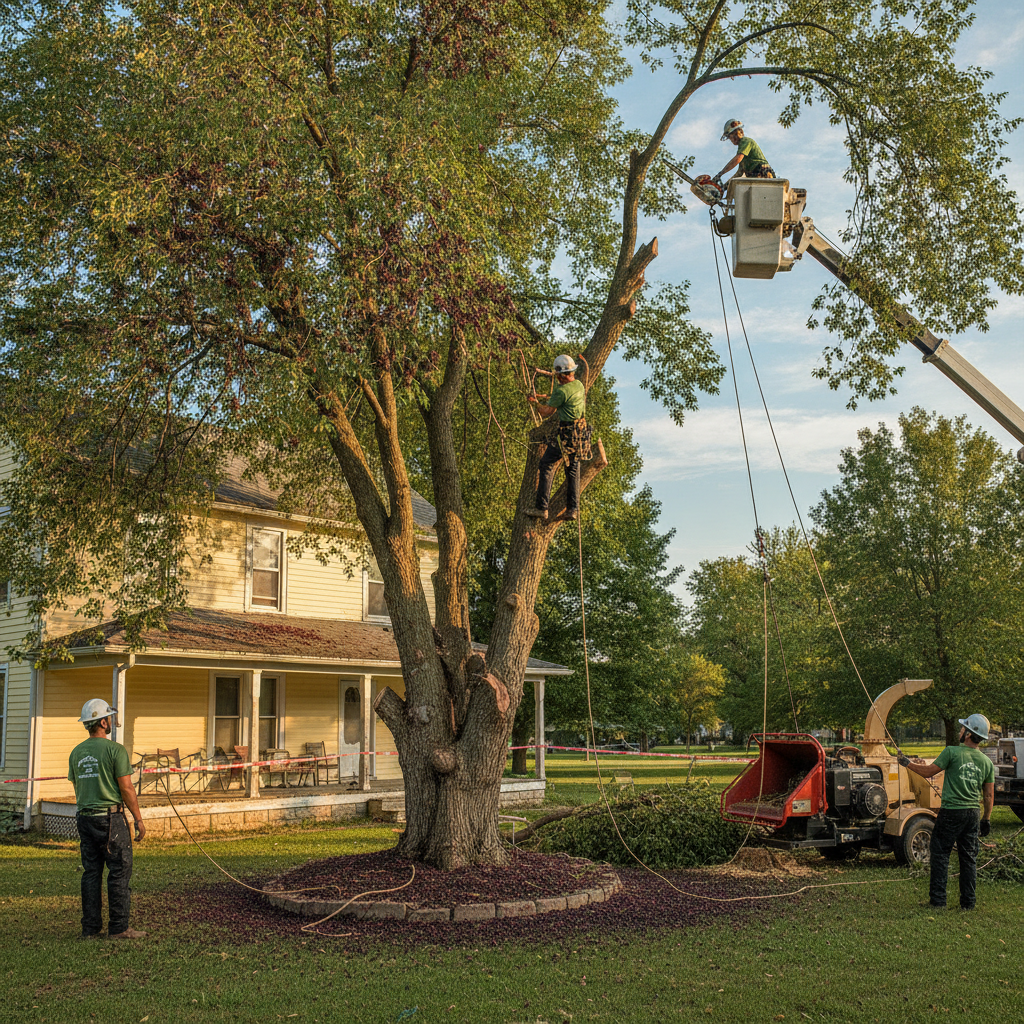
A mulberry comes down like any other yard tree. The provider looks at lean, what sits under the drop zone, and whether the stem has to come out in pieces over a roof, a garage, or a service drop. Open lots along the Wanamaker corridor and out through Silver Lake and Rossville often have room for a chipper and a clear fall. Potwin, Oakland, and the older North Topeka streets usually do not. Short sections, more rigging, more time. A stem that has to come down in short pieces over a garage roof takes more work than the same tree with a clear drop zone. That is what moves the number.
There is no Topeka Tree Pro price for this. One named private provider, Wellnitz Tree Care, publishes an undated cost guide. It is not a market rate, not an average, and not ours, and the guide’s publication date is not established. In that guide, removal of a tree up to 6 inches in diameter runs $200 to $600. Seven to 12 inches runs $500 to $2,000. Thirteen to 20 inches runs $900 to $3,000. Twenty-one inches and up runs $2,000 and up. Stump grinding is listed separately at $175 to $500 or more. Confirm current numbers with the provider who actually bids the job. A fruiting mulberry over a tight Highland Park garage is not the same day as a volunteer on an Osage County fence line, even at the same diameter. Those ranges, with the same caveats, are also on our tree removal cost and stump grinding cost pages.
| What you do | What the tree does next | Why | | Cut the stem at the ground and leave the stump | Sprouts break from the cut and from laterals | The roots still hold the energy that ran the crown | | Cut the tree and grind the stump below grade | The main sprout factory is gone; a few suckers can still appear | Grinding chews the crown; leftover laterals stay in the soil | | Keep the tree and prune for size | Fruit, stain, and seedlings continue | Trimming manages crown size, not the crop or the volunteers |
Cutting at the ground and walking away is how a single stem becomes a thicket. Grinding below grade is the step that usually ends that cycle. Lateral roots remain. A few suckers can still come up in the lawn the next season, and those get handled at ground level. Do not grind next to a buried utility yourself. That is provider work, with locates, not a weekend rental.
Kansas has no statewide tree-service licence and no statewide general contractor licence. Licensing here is local. The City of Topeka licenses contractors who work inside city limits. Most of the smaller towns and counties in this footprint license nothing at all. If the work is inside Topeka, confirm the company’s city licence with the City of Topeka before anyone starts. Ask for the name of the person who will inspect the tree, then check that name in the International Society of Arboriculture’s directory. The ISA Certified Arborist credential belongs to a person, not to a company and not to this brand. The tree-service providers we connect you with are independent and insured. Confirm current proof of insurance with the matched provider before work begins.
A tree in the city right-of-way or on other city property is not the homeowner’s to cut. The City of Topeka Forestry Division is who confirms the tree’s location before anything is scheduled. On the older streets the walk, the planting strip, and the first big stem sit in a few feet of space, and the boundary is often not where a homeowner assumes it is.
If a tree job goes wrong, the Kansas Attorney General’s office is where a consumer complaint about a contractor goes. Look up the current complaint route on the Attorney General’s website.
Common questions
Seedlings, stumps, and roots are three different problems, and they do not share one fix.
Are mulberry trees hard to get rid of?
A first-year seedling in wet soil pulls by hand. A sapling with a woody stem takes a shovel. A mature trunk is the hard one, because the roots store enough energy to resprout after a flush cut. The difficulty is not the felling. It is finishing the root crown so the tree does not return as a thicket.
Will a mulberry tree grow back if cut down?
Yes, if the stump and the upper roots stay in the ground. Stored sugars in that root system push new shoots from the cut face and from laterals. Grinding the stump below grade removes the crown those shoots organize around. A few suckers can still appear from leftover roots. That is a much smaller job than the original tree.
How far do mulberry tree roots go?
There is no single distance that holds for every yard. Mulberry often keeps a lot of root mass near the surface, which is why walks heave and why suckers pop in the lawn a surprising way from the trunk. Clay, water, and pavement change the pattern. An on-site look at the heave and the sucker line tells you more than a number in a paragraph.
How to stop a mulberry tree from growing back?
Take the tree down, then grind the stump below grade so the crown cannot resprout. Pull true seedlings at ground level after rain. Skip homemade cuts on hanging wood, skip ladders, and skip any work near a conductor. Herbicide choices, rates, and timing belong to an applicator, not to a blog post. For a yard tree, grinding is the mechanical answer that does not depend on a mix.
When to call us
A fruiting mulberry over a roof, a walk, or a service drop is not a ladder-and-chainsaw Saturday. Neither is a stump that has already sent a thicket of sprouts. We’ll connect you with an independent insured provider to look at the stem, the drop zone, and whether grinding belongs in the same visit. Call us at (785) 333-4052.