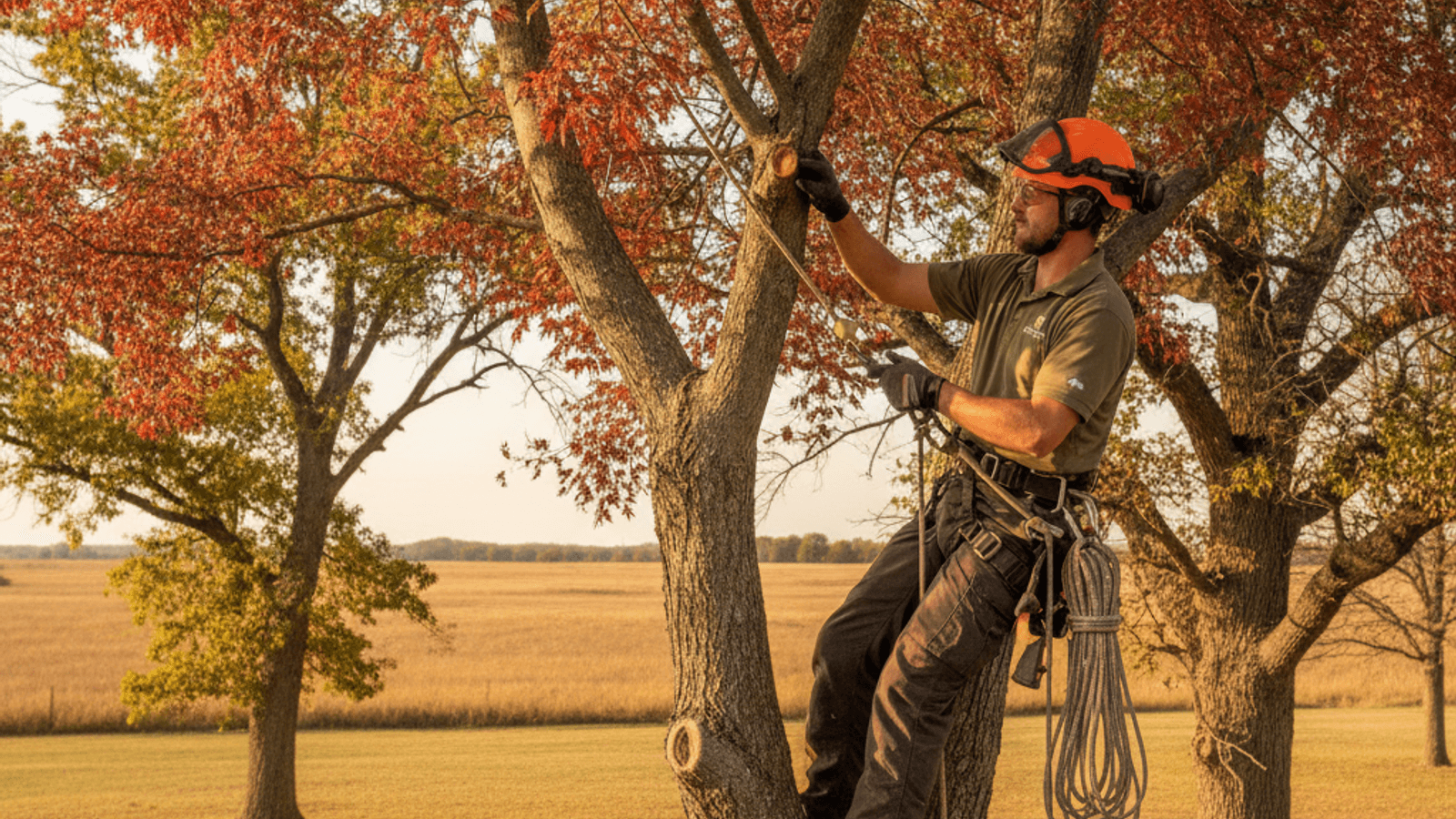
Red maple tree care in Topeka starts with the individual tree and its site. Branch structure, soil, drainage, moisture, light, and previous damage can all affect the next step. Similar symptoms can have different causes, so pruning, treatment, and removal decisions should follow an on-site assessment rather than a neighborhood assumption.
What red maple traits matter in Topeka?
K-State Research and Extension’s Johnson County guidance identifies slow establishment, poor branching, and trunk injuries that can contribute to internal decay. Its long-term shade-tree recommendation applies specifically to the Kansas City area, so it shouldn’t be transferred directly to Topeka. Evaluate the actual tree’s structure, soil, drainage, moisture, light, and root area.
Two Kansas sources disagree on planting red maple, and they should stay in disagreement. That same Johnson County Kansas City agent article says red maples “are not the best choice for a long-term shade tree in the Kansas City area.” The Kansas Forest Service chart Preferred Trees for Northeast Kansas still lists red maple among ten Acer entries. The Johnson County piece is one office’s first-person advice for the Kansas City metro. The Forest Service chart is a consensus list from city foresters, tree boards, extension agents, arborists, and nurseries. We aren’t picking a winner.
That article also limits young-tree watering: “young red maples less then five years old should be watered on a regular basis throughout dry periods.” “The younger the tree, the more often.” “More established trees should be deeply soaked on a monthly basis.” Keep that under-five-years limiter. It is not a watering plan for every maple in the yard.
Branch unions, past damage, decay, and the tree’s surroundings all belong in a structural assessment. A narrow union or visible wound deserves a closer look, but one feature alone doesn’t establish that a tree will fail. Pest or disease concerns also need diagnosis because similar symptoms can come from different causes.
What problems can affect a red maple?
Red maple decline has no single local timeline. The following signs can justify a closer assessment, but none identifies the cause by itself.
Branch structure. Multiple stems, narrow unions, cracks, and torn bark can affect a tree’s condition. Their significance depends on the actual structure and surrounding targets. Stay clear of hanging branches and unstable damaged trees. Dangerous storm damage needs professional assessment, and the utility should handle any electrical hazard.
Leaf spots and leaf loss. K-State’s Johnson County guidance says anthracnose can cause black spots and leaf loss during a cool, moist spring. The effect is often cosmetic, but similar symptoms can have other causes. Confirm the diagnosis before choosing treatment.
Scorch or yellowing. Scorch can develop when leaves lose moisture faster than roots can supply it. Yellowing can also reflect soil, drainage, moisture, or root-zone conditions. Document when symptoms began and where they appear. Our guide to iron chlorosis in Topeka trees explains why look-alike causes should be ruled out first.
Possible pest damage. Insects may be one part of a tree-health problem, but visible decline doesn’t identify a pest by itself. Ask the provider to examine the affected tissue, the wider canopy, and relevant site conditions before recommending treatment or removal.
Storm damage. Broken limbs, hanging branches, cracks, and unstable sections require caution. Stay outside the drop zone and don’t cut branches under tension. Previous damage deserves assessment, but repeated damage or an unchanged appearance doesn’t establish the tree’s current stability.
Red maple trimming strategy
Young red maples may benefit from structural pruning that addresses competing stems and branch unions. The appropriate work depends on the tree’s current form, condition, and location.
Structural pruning when young. A provider can assess competing stems, narrow unions, and the desired mature form. Early pruning can guide structure, but the plan should fit the individual tree rather than promise a future strength or lifespan.
Dead or broken limbs. Have dead, broken, or hanging limbs assessed when you notice them. Keep clear of hazardous branches and unstable trees. The inspection schedule and removal method should reflect the tree, access, and nearby targets.
Avoid topping. Topping leaves large wounds and can create weakly attached new growth. K-State’s storm-damage guidance recommends avoiding this practice. If a red maple conflicts with its space, ask a qualified provider whether selective pruning, monitoring, or removal fits the actual tree.
Late-winter or early-spring timing. K-State generally recommends pruning deciduous trees before bud break, from late February through April. Dead, broken, or hazardous limbs may require different timing. Plant type, condition, and safety still control the decision.
Consider a professional tree health assessment if you’re unsure about your red maple’s structure. Ask the provider to examine branch unions, old damage, decay indicators, pest signs, and site conditions before recommending pruning or removal.
When removal makes sense
Removal can make sense when a red maple has dangerous damage or no longer fits its location. The decision should reflect the tree’s present condition, nearby targets, and the owner’s intended result.
Severe structural damage. Split stems, major wounds, hanging limbs, and instability call for professional assessment. Removal may be recommended when dangerous damage can’t be managed safely. Stay clear of unstable trees while that decision is pending.
Repeated storm damage. A history of lost limbs belongs in the assessment, but it doesn’t prove the remaining tree is stable or unstable. Ask the provider to examine current defects, targets, access, and the intended result.
Suspected disease or pest damage. Similar symptoms can have different causes, so diagnosis should come before treatment or removal. Ask what evidence supports the diagnosis, what outcomes are realistic, and whether monitoring changes the decision.
Space or light conflict. If a red maple’s grown too large for its space, is crowding out other plantings you prefer, or is blocking light from a garden or home, replacement with a smaller species or better-sited tree often makes more sense than constant aggressive trimming.
Replacement based on the site. If removal is part of construction or a landscape redesign, choose the replacement after reviewing soil, drainage, moisture, light, available space, and the desired mature form. Geography alone doesn’t establish which species will perform well on a particular property.
After tree removal, stump grinding can reduce the visible stump below grade. It doesn’t establish that connected roots are gone or guarantee that shoots won’t appear. Ask the provider what area, depth, debris handling, and surface restoration the written quote includes.
What affects a red maple service estimate?
A red maple estimate depends on the actual tree, its condition, access, nearby obstacles, requested work, debris handling, and the intended result. Ask each provider for a written scope that separates pruning or removal, hauling, stump work, and any surface restoration. Compare the same scope instead of relying on a typical price that may not fit the job.
Verify the provider’s qualifications and insurance directly. Within Topeka city jurisdiction, regulated tree businesses must hold a city clerk license. Work on city-owned property or a city right-of-way may also require a Division of Forestry permit. Ask the provider to confirm its license status and which permissions apply to the actual location before work begins.
Frequently asked questions
How long do red maples typically live in Topeka?
A red maple’s lifespan in Topeka can’t be predicted from a fixed local number. Site moisture, drainage, light, structural condition, and previous damage can all affect an individual tree. An assessment can describe its present condition without promising how long it will remain viable.
Will a red maple survive a Topeka winter?
A red maple’s winter outlook depends on the individual tree and its site. Cold exposure, moisture, branch structure, and previous damage can matter. After a damaging event, stay clear of hanging limbs and have unstable sections assessed.
Can you save a red maple that’s lost a major limb?
Sometimes, but the remaining structure needs professional assessment. Stay clear of hanging branches, unstable sections, and limbs under tension. Severe damage may require removal, while other trees may remain manageable after appropriate pruning.
Do red maples need fertilizer in Topeka?
Fertilizer shouldn’t be chosen from leaf color or slow growth alone. Similar symptoms can reflect different causes, including soil, drainage, moisture, or root-zone conditions. Ask a qualified provider to diagnose the problem before selecting an amendment or treatment.
What’s the best replacement if you remove a red maple?
There isn’t one best replacement for every Topeka property. Match the choice to soil, drainage, moisture, light, available space, and the desired mature form. Ask the provider to explain why a proposed species fits the actual planting site.
If you’re deciding whether a red maple needs pruning, assessment, or removal, Topeka Tree Pro can connect you with an independent licensed and insured tree-service provider in Greater Topeka. Call (785) 333-4052 to request an estimate, then confirm estimate or visit fees, availability, qualifications, and the written scope.