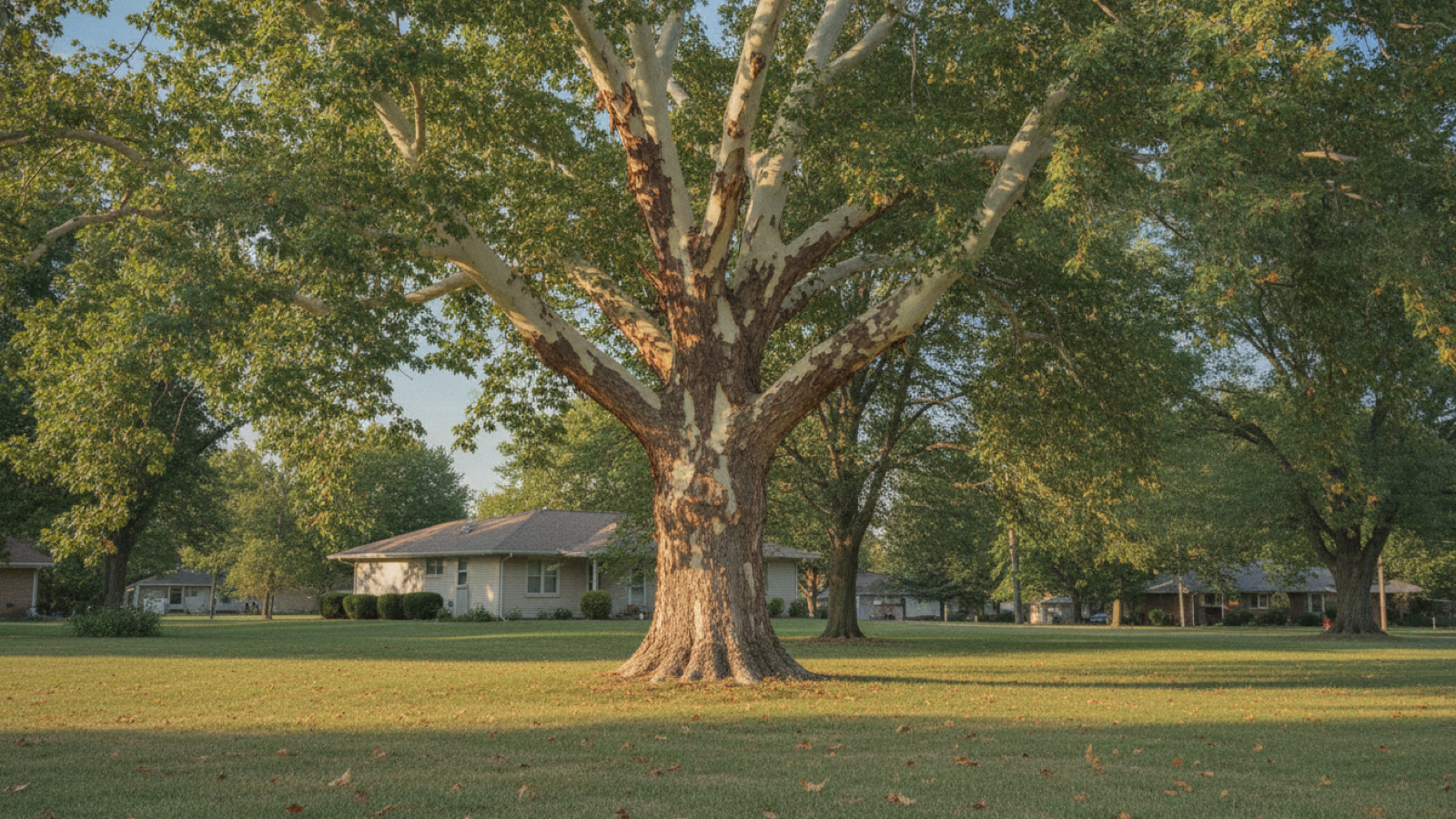
K-State lists six sycamore tree problems in one Kansas reference table: anthracnose, bacterial wetwood, powdery mildew, sycamore lace bug, environmental scorch, and shedding bark. Their symptoms can overlap with other problems. An in-person assessment can separate foliage concerns from structural damage.
That answer comes from K-State’s Tree and Shrub Problems in Kansas. Its sycamore and London plane table is much narrower than national problem lists. National lists often add bacterial leaf scorch and canker stain. MF3132’s Platanus table does not carry those rows. Naming them here only marks that they are out of the Kansas table, not that they are or are not on a Topeka tree. Those names still need on-site diagnosis.
What are the most common sycamore tree problems in Kansas?
K-State’s Platanus table covers six specific problems. It doesn’t present any listed symptom alone as a reason for removal.
| Problem | What K-State describes | Management direction |
|---|---|---|
| Anthracnose | Brown areas along veins, falling young leaves, and killed twigs | Primarily cosmetic, with no management usually needed |
| Bacterial wetwood | Oozing liquid and discolored trunk or branch streaks | Primarily cosmetic, with management unnecessary |
| Powdery mildew | White, powdery fungal growth across leaf surfaces | Primarily cosmetic, with no management necessary |
| Sycamore lace bug | Light-yellow mottling or stippling on upper leaf surfaces | Generally doesn’t cause severe plant damage |
| Environmental scorch | Brown, dry margins or leaves during dry, windy conditions | Provide water and use mulch to retain moisture |
| Shedding bark | Loose bark plates leaving limbs and trunks | Cosmetic, with management unnecessary |
Several entries are described as cosmetic or unlikely to cause severe damage. Environmental scorch receives different guidance involving moisture and mulch. Those entries don’t diagnose a particular tree or rule out other causes. Compare the visible symptoms, site conditions, and branch structure before choosing any work.
Guidance from another region may reflect different weather, species, or disease pressure. Start with Kansas sources, then have uncertain symptoms evaluated before selecting treatment.
K-State also names sycamore among six Kansas hosts where anthracnose is most common. The others include elm trees affected by Kansas diseases, walnut trees in Topeka, and red maple trees.
The site’s Kansas bagworm guide separately mentions sycamore as a host. Bagworms aren’t among the six problems in K-State’s Platanus table, though, so that’s a different question and shouldn’t get folded into this one.
Is my sycamore’s brown, ragged spring growth anthracnose?
It could be anthracnose, but those symptoms don’t prove it. K-State describes “Brown irregular areas along veins. Young leaves turn brown and fall off. Twigs may be killed”.
The fungus spends the winter right there in the tree. K-State says “Anthracnose fungi survive the winter in infected twigs and fallen leaves.” and that “Infection occurs in cool weather just as buds open.” So the damage you’re looking at in August was set in motion back in April.
Plenty of other things look like this, which is the part most pages skip. K-State says the same symptoms get “confused with herbicide injury, environmental scorch, or frost injury, especially during spring weather fluctuations.” Reading brown leaves from the ground isn’t a diagnosis.
Repeated twig loss can also affect the crown’s form. K-State says repeated damage can produce abnormal branching and a ragged appearance.
That possibility doesn’t establish the cause or severity from the ground. A tree health assessment can compare foliage symptoms, deadwood, and visible structural concerns.
What does Kansas guidance say about sycamore anthracnose?
K-State’s answer is usually to let the foliage recover. Its publication says, “Although anthracnose diseases are unsightly, they do not kill or weaken the plant.”
The same guidance adds, “In particular, large, mature trees tend to recover rapidly if properly maintained.” Warm, dry summer weather speeds recovery as the tree produces more foliage.
On treatment it’s blunter still: “Fungicides are rarely needed.” Where one is used, K-State says “The typical recommended timing to initiate foliar applications is at or just before bud break.” and that “Fungicide applications later in the season have minimal effect.”
The timing is tied to bud development rather than a fixed Topeka date. A provider should first confirm the problem and whether treatment is appropriate.
Dead twigs or structural defects may justify selective pruning. The written scope should identify the affected branches and intended result before work begins.
Did Topeka’s wet spring set this up?
Topeka got the spring condition K-State names, and that’s as far as the evidence goes. It doesn’t prove a single tree in town got infected.
NOAA records for Topeka Billard Municipal Airport measured 6.36 inches of rain during April 2026. The station’s 1991 to 2020 April normal is 3.81 inches. Measurable rain fell on 11 April days.
K-State says anthracnose fungi “cause new infections during wet spring weather.” The measured rainfall fits that condition, but nobody surveyed Topeka sycamores for an outbreak.
May brought 5.99 inches against a 5.17-inch normal. Again, rainfall describes weather, not disease incidence.
Is it a sycamore or a London plane, and does it matter?
Yes, the distinction matters because susceptibility changes by problem. K-State gives homeowners a useful two-part comparison.
For anthracnose, “London plane is less susceptible than sycamore.” For powdery mildew, the relationship reverses: “London Plane is more susceptible than sycamore.”
The comparison shows why species identification matters during an assessment. Vein-associated browning and white fungal growth remain symptoms, not diagnoses. Site conditions and other possible causes still need consideration before treatment.
Powdery mildew appears as white, powdery fungal growth on leaves. K-State still calls it rarely damaging and primarily cosmetic. The publication says management isn’t necessary.
When identification remains uncertain, an arborist consultation can prevent treatment aimed at the wrong problem.
What the lace bug does, and why the stippling is on top
Lace bug damage shows up as “light-yellow mottling or stippling on the upper leaf surface”, and that’s the detail worth holding onto. You’ll see the damage on top of the leaf while the insect sits underneath it, which is why people flip a leaf over and find nothing on the side they were staring at.
The adults are small. K-State puts them at “1/8 to 1/4 of an inch long” with lacy, clear, shiny wings held flat over the body.
K-State describes severe plant damage as unlikely, while noting visible appearance changes. Correct identification can help a provider decide whether any response is warranted.
Peeling bark and oozing streaks are on the cosmetic list too
K-State describes loose bark plates on sycamore limbs and trunks as cosmetic. Peeling that matches this normal pattern differs from a wound, crack, cavity, or unstable branch. Have uncertain trunk damage assessed rather than identifying it from one sign.
Wetwood is the wet-looking streak down the trunk. K-State describes liquid that “oozes from wounds and cracks and runs down bark, leaving discolored streaks on branches or trunk”, and calls it “Rarely damaging, primarily cosmetic, management not necessary.”
K-State associates environmental scorch with brown, dry leaf margins during dry, windy conditions. Similar symptoms can have other causes. Soil moisture, drainage, and the tree’s condition should be checked before changing care.
Here’s the catch with all three. None of them tells you a thing about whether the limbs over your driveway are sound. A trunk can look terrible while the actual risk is forty feet up.
When a sycamore problem is actually a structure problem
Structure moves to the front the moment repeated twig loss starts changing the shape of the crown. Dead branches, cracked unions, hanging limbs and dieback that keeps coming back are all things somebody has to look at in person.
A tree risk assessment in Topeka considers targets, branch condition, and likely consequences. It answers a different question than leaf diagnosis.
Selective sycamore tree trimming may address confirmed deadwood, damage, or clearance needs. Ask the provider to identify the branches included and the intended result. Size, access, obstacles, and scope all belong in the written estimate. The tree trimming cost guide explains how to compare that scope.
Owners can also compare symptoms with the site’s guide to recognizing a dead or declining tree. Leaf discoloration alone doesn’t establish that conclusion.
Tree removal remains the last resort, not the default response. K-State’s six listed problems don’t justify removal by themselves.
Frequently asked questions
What sycamore tree problems does K-State list?
K-State lists anthracnose, bacterial wetwood, powdery mildew, sycamore lace bug, environmental scorch, and shedding bark. It doesn’t treat any of those six as a removal diagnosis.
Does sycamore anthracnose kill or weaken the tree?
K-State describes the anthracnose covered in its guidance as unsightly rather than weakening. That statement doesn’t confirm anthracnose from brown leaves alone. An assessment should consider competing causes and any separate structural damage.
Should I spray a sycamore with anthracnose in August?
Don’t choose a spray from leaf symptoms alone. K-State says fungicides are rarely needed and later applications have minimal effect. Ask a qualified provider to confirm the diagnosis and appropriate timing before treatment.
Are London plane tree problems the same as sycamore problems?
They overlap, but susceptibility can differ. K-State describes London plane as less susceptible to anthracnose and more susceptible to powdery mildew. Species identification helps narrow the possibilities, but it doesn’t diagnose the visible symptom.
Why are my sycamore’s leaf edges brown?
Environmental scorch is one possibility, but brown edges aren’t diagnostic. K-State associates scorch with dry, windy conditions. Check moisture, drainage, other symptoms, and deadwood before deciding how to respond.
Could yellow sycamore leaves be iron chlorosis?
They could be, and two K-State publications handle it differently. MF3132’s Platanus table doesn’t carry an iron chlorosis row at all, while MF718 puts sycamore in its second tier of species that “may develop iron chlorosis.” We’re not going to referee that here, and neither should a homeowner reading leaf color from the driveway.
The site’s iron chlorosis guide for Topeka trees explains the broader symptoms. An on-site assessment should settle the diagnosis before treatment.
When should I call about a sycamore problem?
Call when deadwood, cracked branches, or repeated twig loss affects the crown. You don’t need to wait for the whole tree to decline. A structural review can separate cosmetic symptoms from work that protects nearby targets.
Get the structure checked before choosing treatment
Topeka Tree Pro connects Greater Topeka property owners with independent insured tree-service providers. Ask the matched provider to assess the symptoms, branch structure, access, and proposed scope.
Call (785) 333-4052 to request an estimate through our Topeka tree service area. Verify availability, qualifications, and the written scope directly with the provider.