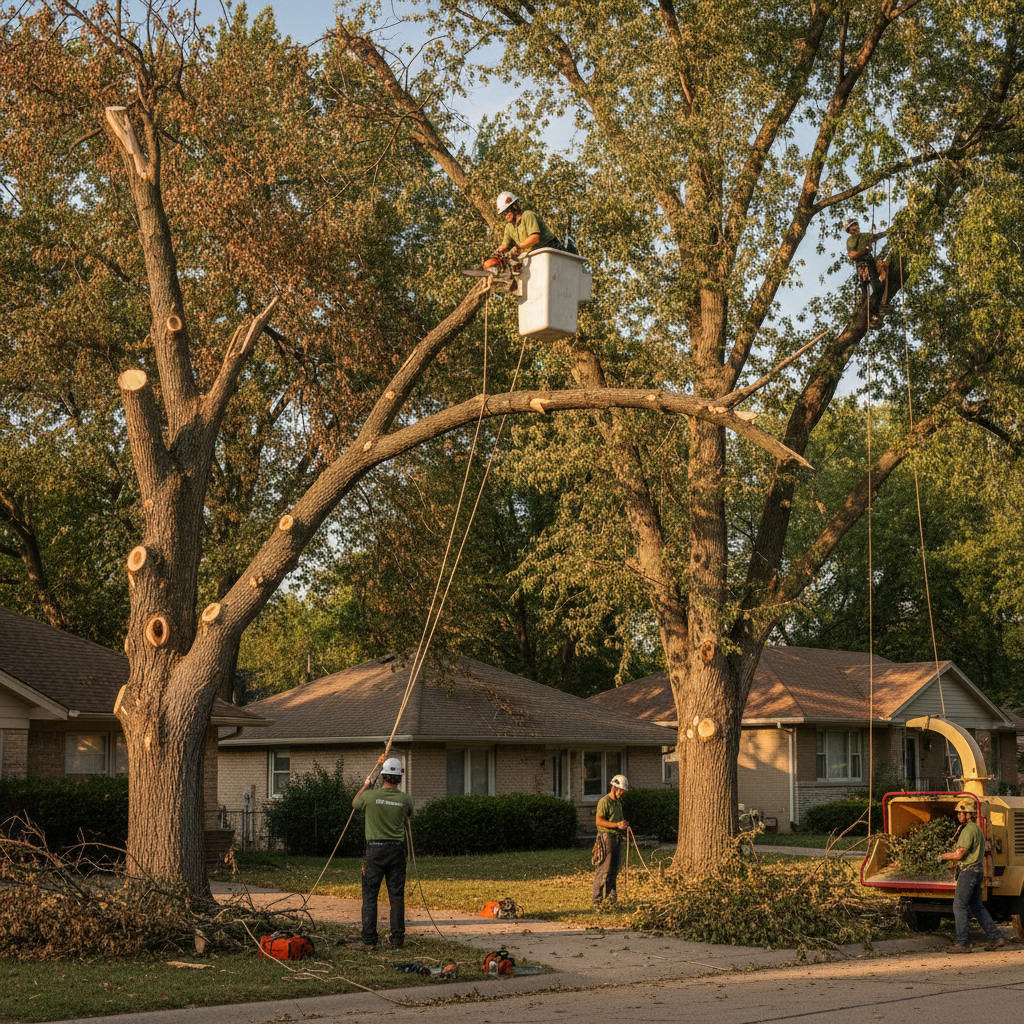
The morning after a Shawnee County hail cell, Highland Park lawns look like a shredder ran through the canopy. Torn silver-maple leaves plaster the sidewalk, and the west side of a young honey locust on a Wanamaker lot is pocked where the ice hit. Hail damage on trees is mostly stripped foliage and wounded bark, not an automatic death sentence. Wait for a new flush when the wood is still in one piece. Get an insured provider involved when a limb is hanging, a stem is split, or a branch is anywhere near a line.
What hail actually does to leaves and young bark
Hail is ice thrown by a thunderstorm, and Topeka sits in the northeast Kansas severe-weather corridor where large hail and straight-line wind are spring routines, not freaks. Peak severe season runs roughly March into June. The National Weather Service Topeka office is where watches, warnings, and storm reports for this footprint live.
Leaves take the first hits. A stone punches through a blade or tears it along the veins. A mature bur oak over a Potwin garage can lose a lot of leaf area and still read as a tree. A newly planted redbud in Westboro or a thin-barked maple in a Silver Lake front yard can look skinned after a single cell, because there was less canopy to absorb the ice.
Twigs snap next. Small-diameter wood, the stuff that still has green bark, is brittle under a hard strike. You will find those sticks mixed in with the leaf litter. That mess on the ground is often a better first read than staring up into a shredded crown the same afternoon.
Bark is the injury that lasts. Hail wounds tend to be oval, on the upper face of a limb or on the windward side of a trunk. Thin bark on young maples, lindens, and fruit trees bruises and splits. Thick, corky bark on an Osage orange hedge row in Osage County, or on a mature hackberry in Oakland, shrugs off a lot of the same storm. Wind matters. Ice driven sideways strips more bark than ice falling straight down.
Just under the bark is the living layer that moves water and sugars. A shallow pit may close with callus wood over coming seasons. A wound that cuts through that layer girdles a twig, and everything beyond the hit dries out. That dieback can show up later, which is why a pine or spruce that looked merely dinged in June can bronze as the bark separates and the twig desiccates. Hardwoods in this metro, oak, silver maple, cottonwood, elm, hackberry, often look worse the day after and better after a flush. Conifers do not replace a season’s needles the same way.
This is a different injury from winter ice. Freezing rain loads a union until it fails. Hail is ballistic. A tree that rode out an ice storm with a few broken limbs can still look stripped after a spring cell, and the reverse is true. If the damage you are staring at is loaded, bent wood rather than pocked bark, that is closer to ice-storm failure than to hail pitting.
None of this is a diagnosis of the tree in your yard. A species, an age, or a phone photo does not establish that a particular stem will fail.
When to wait for a flush versus when wood is split
A healthy tree stores a lot of its energy in the roots, and hail does not smash the root plate. When leaves are gone and the twigs are still attached, the usual response is a second flush: dormant buds push new, often smaller leaves. The crown can look thin for the rest of the growing season. That is the tree spending savings, not a sign it is already dead. A cottonwood on the Kansas River bank at NOTO can look wrecked after a cell and still push a full set of leaves because the roots never stopped.
- Intact stems with pitted bark and missing leaves are spending stored root energy on a new flush, not announcing that the tree is dead.
- A hanging limb, a stem split into the trunk, or wood resting toward a line is a hazard now, and new leaves will not close that failure.
Wait on a tree whose main stem is still round, whose big unions are not split, and whose wounds are pits in bark rather than cracks into the wood. Give it the next flush, then the next dormant season, before anyone talks about taking it down. If you are trying to tell whether the tree has any living tissue left at all, how to tell if a tree is dead is the closer read than a same-day panic cut.
Do not wait on hanging wood. A limb torn and still attached is under tension. It is not a weekend project on a ladder, and it is not a chainsaw job from the ground if it sits over a roof, a drive, or a play set. Ground-level raking of shredded leaves and small sticks is the DIY that belongs here. Overhead storm wood is storm damage cleanup for an independent insured provider, not a flush you sit out.
Split wood is the other line. A leader split into the trunk, a co-dominant union opened by the wind that rode with the hail, a stem cracked so you can see inside: those are structural failures. New leaves will not glue that union back together. On a tight Potwin, Oakland, or North Topeka lot, that split often sits over a house, a garage, or a sidewalk. That is a tree removal conversation, or at least an on-site look at whether the remaining tree can be reduced and watched. No living tree can be certified safe.
Broken twigs still on the tree can come off with proper tree trimming. K-State Research and Extension puts routine pruning of many deciduous trees in late February through April, before bud break, and treats dead or damaged wood as something that can come out any time. Storm-broken wood is the any-time case. Ask a provider to cut back to living wood at a proper collar, not to paint the wounds, and not to top the tree to even it up. Topping forces weakly attached water sprouts and spends the same energy the tree needs to close hail pits.
Interior sprouts after a heavy strip are the tree making shade for newly exposed bark and making sugar. Leaving them until the outer canopy fills back in is usually the kinder read. Stripping them the week after the storm is another injury, not a cleanup.
Young trees in the newer stock along Wanamaker, out through Silver Lake and Rossville, and on acreage at Auburn, Berryton, or Overbrook take hail harder on the stem because the bark is thin and the leader is still small. A split leader on a young tree is a structure problem for the life of that planting. A defoliated leader that is still in one piece is often a wait. Out in Wabaunsee County, a cedar in a windbreak can bronze after impact the same way a yard spruce does. That browning is the foliage reacting, not proof the whole row is finished.
If a branch is on or near an Evergy line, stop. Evergy’s own guidance is that the pole-to-pole span is theirs to review, and the line from the pole to the meter is the customer’s responsibility, which still does not mean you touch it. Call Evergy’s vegetation line at 888-471-5275 first. Never move a branch that is contacting a conductor.
An ash already thinning in this footprint is a stacked stress if hail then takes its remaining leaf area. Emerald ash borer was confirmed in Shawnee County in 2017, Jefferson in 2015, Jackson in 2019, and Osage in 2022, per the Kansas Forest Service county list. A county listing is not a diagnosis of the tree in your yard. It is a reason not to assume a half-naked ash is only hail if the crown was already thin.
Insurance notes after a Topeka hailstorm
A hail cell in Greater Topeka often hits cars, roofs, and trees in the same storm, and those are not the same claim. Your policy, not a blog post, decides what is covered. Photograph everything the same day, and call the carrier before you assume the tree work is or is not part of the claim.
We do not quote coverage, deductibles, or what an adjuster will accept. That is their job. What helps the conversation is a clear record: the date of the cell, which NWS Topeka’s storm reports can help pin down, photos of the tree from several sides, photos of shredded leaves and broken twigs on the ground, and photos of anything that landed on a roof, fence, or vehicle. A limb that came down on a structure is a different fact pattern from a tree that only lost leaves. Our page on homeowners insurance and tree removal in Topeka walks that split in local terms.
The tree work itself is a separate bill from a provider, even when a carrier is involved. Confirm the estimate, the scope, and current proof of insurance with the matched provider before anyone starts. Kansas has no statewide tree-service licence and no statewide general contractor licence. Licensing here is local. The City of Topeka licenses contractors who work inside city limits. Most of the smaller towns and counties in this footprint license nothing at all. If the work is inside Topeka, confirm the company’s city licence with the City of Topeka. Ask for the name of the person who will actually look at the tree, then check that name in the ISA’s Find an Arborist directory.
A tree in the strip between sidewalk and curb is often not yours to cut, even when hail shredded it. Confirm location with the City of Topeka Forestry Division before anyone schedules work on a street tree. On Perry Lake shoreline or other Corps of Engineers land in Jefferson County, who owns the tree is a different answer again, and that authority comes first.
If a job goes wrong, the Kansas Attorney General’s office is where a consumer complaint about a contractor goes. Look up the current complaint route on the Attorney General’s website.
Will homeowners insurance pay for hail damage on trees?
The policy and the adjuster answer that, and the answer often turns on whether the tree damaged a covered structure or only lost leaves and bark. Photograph the tree, the debris, and anything that hit a roof, fence, or car, then call the carrier with that record. Do not treat a blog as a coverage promise.
Is it safer to park under a tree during a hailstorm?
A canopy is not a garage. The same cell that throws ice often throws limbs, and a silver maple that has been dropping wood on a Potwin driveway since the last ice storm is a poor roof. If you have a garage, use it. If you do not, an open pad away from large unions is the less bad option, and neither spot is a guarantee.
How big does hail have to be before it hurts a tree?
There is no single stone size that starts tree damage. Tender spring leaves bruise under small ice. Thin bark pits when stones are driven by wind. Larger stones snap twigs and can wound a trunk. Watching your own tree for shredded leaves, pitted bark, and split wood tells you more than a diameter, and NWS Topeka is the place for the storm report.
What does hail damage look like compared with a lightning strike?
Hail peppers many small oval wounds on the windward side and shreds leaves. Lightning typically follows the stem, blows a long strip of bark, and can split or shatter wood along a spiral. They can arrive in the same storm. A long vertical bark strip or exploded wood is not hail pitting, and it deserves an on-site look rather than a wait-and-see flush.
When to call us
Call when a limb is hanging, a stem is split, wood is near a line, or you want an insured provider to look at whether a hail-stripped tree still has a structure worth keeping. Topeka Tree Pro matches Greater Topeka property owners with independent insured tree-service providers. The line is answered, and storm work is arranged as providers have capacity. Call us at (785) 333-4052.