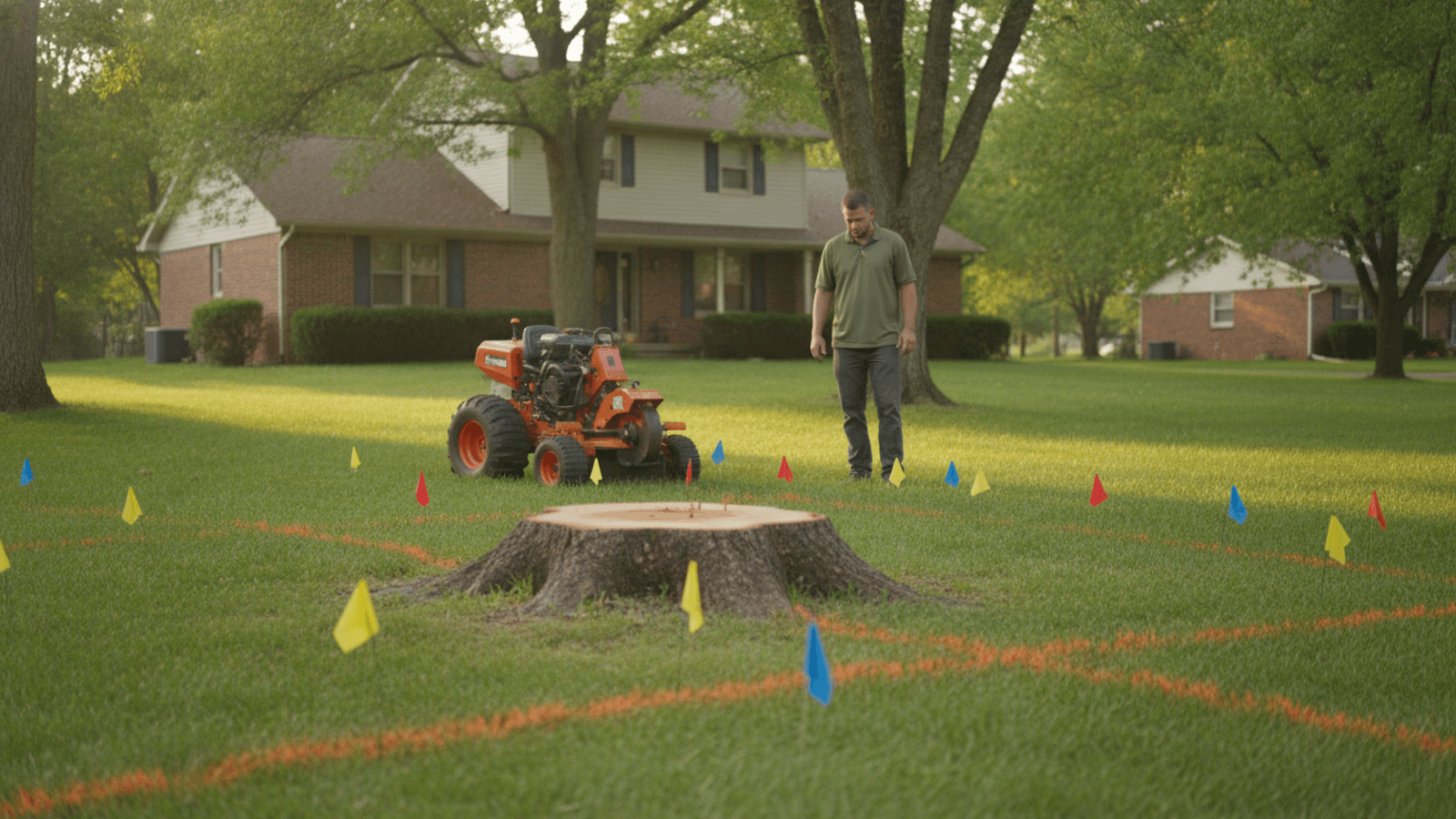
Kansas puts the legal duty to notify 811 on the tree crew you hire, not on you. The state’s one-call act writes homeowners out of the definition of “excavator” when they’re digging at their own primary residence. That’s a narrower piece of good news than it sounds, because the exemption removes a duty, not a gas line. Here’s who has to call before a stump gets ground in Topeka, what a Kansas 811 ticket actually gets marked, and which lines nobody is required to mark at all.
Why do buried utility lines matter for stump grinding?
Because grinding works below grade, and that’s where buried facilities live. Cutting a tree down stays above the surface. Taking the stump out doesn’t.
That’s the difference the rest of this article turns on. A stump grinding job displaces soil and roots in the exact band of ground where gas, electric, water, and private lines run. So the question stops being about trees and starts being about who was told to come mark the yard.
Does stump grinding count as digging under Kansas law?
Yes, when the work moves or displaces material below the surface.
K.S.A. 66-1802(d) defines excavation as “any operation in which earth, rock or other material below the surface is moved or otherwise displaced by any means, except tilling the soil for normal agricultural purposes, or railroad or road and ditch maintenance that does not change the existing railroad grade, road grade and/or ditch flowline, or operations related to exploration and production of crude oil or natural gas, or both.”
That exception list contains no tree, stump, or landscape work. Grinding a stump below the surface therefore fits the statute’s excavation definition.
The same issue can arise during tree removal near buried utilities. Removing the trunk alone may remain above grade. Displacing soil or roots below the surface brings the excavation rules into the job.
Who has to call Kansas 811, you or the tree crew?
The hired tree crew carries the statutory duty because it performs the excavation.
K.S.A. 66-1802(e) defines an excavator as “any person who engages directly in excavation activities within the state of Kansas, but shall not include any occupant of a dwelling who: (1) Uses such dwelling as a primary residence; and (2) excavates on the premises of such dwelling.”
That exemption applies only to an occupant digging at a primary residence. It removes a statutory duty from that qualifying homeowner. It doesn’t make buried facilities safe or make a locate request unnecessary.
Kansas 811’s homeowner guidance says, “You MUST contact Kansas 811 two (2) full working days (not including weekends and holidays) in advance of your digging project.” The same page adds that “this notice does not include the day the locate request is made,” so the day you file doesn’t count toward the two.
So read the exemption for what it is. It decides who the law can penalize, not whether your yard is safe to grind. A homeowner can still file, and Kansas 811 says calling “gets your underground utility lines marked for free.” If you’re hiring the work out, ask the crew for its ticket before the grinder comes off the trailer.
What a Kansas 811 ticket gets marked, and what it doesn’t
Kansas law treats tier 1 and tier 2 facilities differently.
Tier 1 includes gas, electricity, communications, crude oil, refined or reprocessed petroleum, petroleum products, and hazardous liquids. Tier 2 includes potable water or sanitary sewage.
K.S.A. 66-1804(a) states: “Except in the case of an emergency, an excavator shall serve notice of intent of excavation at least two full working days but not more than 20 calendar days before the scheduled excavation start date, on each operator having underground tier 1 facilities located in the proposed area of excavation.”
The wording changes for tier 2 facilities. K.S.A. 66-1804(b) says: “An excavator may serve notice of intent of excavation at least two full working days but not more than 20 calendar days before the scheduled excavation start date, on each operator of tier 2 facilities located in the proposed area of excavation.”
One word carries the whole difference. “Shall” makes tier 1 notice mandatory for an excavator. “May” makes tier 2 notice permissive under that section, and tier 2 is where potable water and sanitary sewage sit. That notice stays valid for 20 calendar days after the excavation start date.
This distinction matters during stump grinding work. A visible utility mark doesn’t prove that every public or private facility has been identified.
Which lines is nobody required to mark?
Utilities aren’t required to mark privately owned facilities.
K.S.A. 66-1805(p) says utilities “are only required to identify the location of utility-owned facilities and are not required to identify the location of privately owned facilities.”
K.S.A. 66-1802(k) also excludes “any person who is the owner of real property wherein is located underground facilities for the purpose of furnishing services or materials only to such person or occupants of such property” from the definition of an operator.
Kansas 811 identifies examples such as pool heating systems, outbuilding electricity, invisible fences, septic systems, sprinkler systems, and satellite dishes. These private facilities can cross the same area as a stump or root system.
Tell the crew about every private facility you know is present. Existing paint or flags don’t establish that privately owned lines have been identified, and they don’t guarantee that every facility in the work area is marked.
If a private line’s route is unknown, don’t guess or rely on a homemade mark. Kansas 811 advises hiring a private utility locator to identify privately owned facilities. Keep grinding equipment away until the work area and the appropriate safety response are clear.
What the law says about lines installed years ago
Kansas sets locatability requirements based on installation dates.
K.S.A. 66-1806(h) says, “All tier 1 facilities installed by an operator after January 1, 2003, shall be locatable.”
K.S.A. 66-1806(i) says, “All tier 2 facilities installed by an operator after July 1, 2008, shall be locatable.”
Those sections establish requirements for facilities installed after their stated dates. They don’t say facilities installed earlier are unlocatable.
Age doesn’t tell you how deep anything sits either. Work from the marks and from what you know about your own lines, never from a guess about depth.
Who is protected if a line gets hit?
The statute provides a specific protection for an excavator that gave notice.
K.S.A. 66-1806(e) covers situations where notice was given and an operator failed to mark or reported no facilities. It says “the excavator may proceed and shall not be liable to the operator for any direct or indirect damages resulting from contact with the operator’s facilities, except that nothing in this act shall be construed to hold any excavator harmless from liability to the operator in those cases of gross negligence or willful and wanton conduct.”
This isn’t blanket protection. The provision names the excavator and retains its stated exceptions.
A homeowner may still submit a Kansas 811 request. Filing doesn’t rewrite the homeowner into the statute’s excavator definition, though. The provision also doesn’t decide responsibility for every particular incident or repair.
What to do before a Topeka stump grinding or removal job
Coordinate the notice before any below-grade work begins. If you’ve hired a tree crew, ask for its Kansas 811 ticket and confirm the proposed excavation area matches the actual work.
Use this checklist:
- Walk the work area, including the stump and surrounding roots.
- Confirm the required notice was submitted within the statutory timeframe.
- Ask the hired crew for its ticket before equipment enters the work area.
- Review the responses and markings for utility-owned facilities.
- Identify known private facilities and hire a private locator when a route is unknown.
- Show the provider the full work area, obstacles, and private-line information.
- Keep work stopped if a marking, response, or electrical hazard remains unresolved.
Whitelining can also define the proposed excavation area. K.S.A. 66-1804(g) states, “The person filing the notice of intent to excavate shall, at the request of the operator, whiteline the proposed excavation site.”
K.S.A. 66-1803 adds: “An excavator shall not engage in excavation near the location of any underground facility without first having ascertained, in the manner prescribed in this act, a location of all underground facilities in the proposed area of the excavation.”
Which service you need depends on what’s left in the ground. A stump on its own is stump grinding in Topeka. A tree still standing is tree removal. A property with a run of volunteer trees along a fence is lot clearing.
Two related reads: what drives stump grinding cost in Topeka, and what to do when tree roots lift a sidewalk, which is the same conflict above grade instead of below it.
Frequently asked questions
Should I call Kansas 811 before stump grinding?
Yes. Kansas 811 instructs homeowners to contact it two full working days before digging, excluding weekends and holidays. Kansas 811 says the call “gets your underground utility lines marked for free,” and a homeowner can submit the request.
Does Kansas 811 mark private lines?
No. Utilities are required to identify utility-owned facilities, not privately owned facilities. Sprinkler systems, invisible fences, and electricity serving an outbuilding may need a private utility locator. Don’t infer their routes from public utility markings.
How deep are utility lines near a stump?
There’s no safe assumed depth for planning this work. Follow the location information and account separately for private facilities.
Are water and sanitary sewage treated like gas and electricity?
No. K.S.A. 66-1804 says an excavator “shall” notify tier 1 operators but “may” notify tier 2 operators. Potable water and sanitary sewage fall within tier 2.
Does tree removal count as excavation?
It does when the operation moves or displaces material below the surface. Kansas’s excavation definition doesn’t contain an exception for tree or landscape work.
Connect with a Topeka tree crew
Topeka Tree Pro connects Greater Topeka homeowners with independent insured tree-service providers. See tree service in Topeka or call (785) 333-4052. Before work begins, ask the provider to confirm the notice, the marked work area, and the plan for private lines.